Is Day Trading Worth It? We Tested 24 Day-Trading Strategies. One Passed.
We tested 24 popular day-trading strategies with fixed rules, real costs and a test on new data. 14 had no reliable edge, 9 had a real one that was too small or eaten by costs, and one passed.
Is day trading worth it?
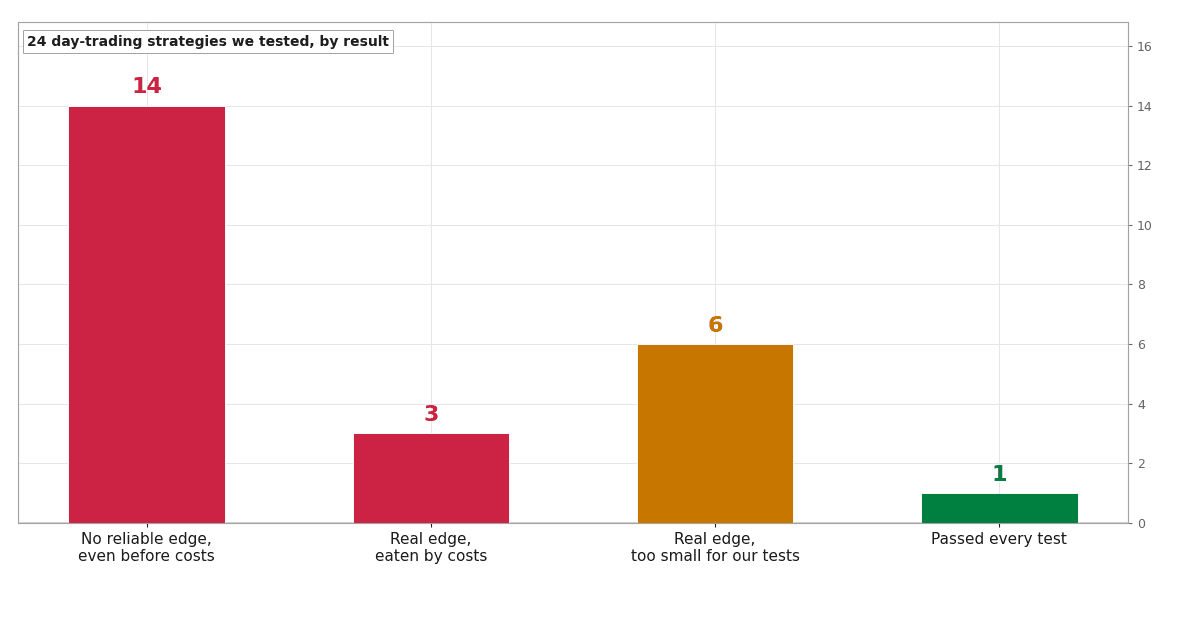
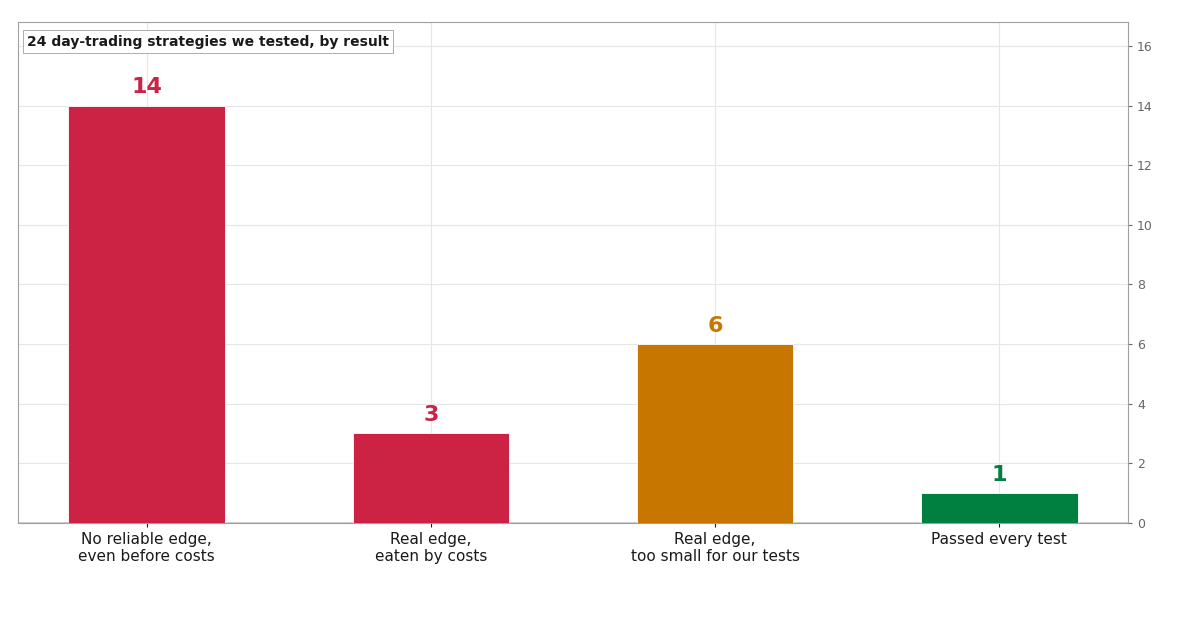
For most popular day-trading setups, no. We tested 24 of them with fixed rules, real spreads and commissions, and a test on data the rules had never seen. 14 had no reliable edge even before costs, 3 had a real edge that costs ate, 6 had a real edge too small to pass our tests, and one passed every test, earning about 6% a year at 1% risk per trade.
The Backtest Files: the exact rules of each strategy we've put on trial, how we tested it and what the data showed. Free with your email.
The short answer
For most of the day-trading strategies people share online, no.
We have now tested 24 strategies that open and close a trade on the same day. Each one got the same treatment: rules written down before testing, real spreads and commissions, and one test on data the rules had never seen. Here is how they came out:
 24 day-trading strategies we tested, by result
- 14 had no reliable edge, even before costs. The pattern either did not exist or was too weak to tell apart from chance.
- 3 had a real edge that trading costs ate. The price did what the strategy expected, just by less than the spread and commission.
- 6 had a real edge that was too small to pass our tests. Some made money out of sample, but not enough, or not steadily enough.
- 1 passed every test. It makes about 6% a year at 1% risk per trade.
That is one in 24.
How we tested them
Every strategy went through the same process, described in full on our How We Test page:
- Rules first. We wrote down the exact entry, exit and stop before looking at any results, so we could not tune them to the past.
- Real data and real costs. Tick or one-minute data, the broker's real spread at each moment, and commission on every trade.
- One test on new data. After the first test, the rules were frozen and run once on years they had never seen.
- Fourteen pass or fail checks. Enough trades, a profit factor that holds up, drawdown that does not blow up, a profit in most years, and more.
Many of the strategies were dropped before we wrote any trading code, because a simple measurement already showed the edge was not there.
The famous ones
Some of the setups that did not survive:
- ICT Silver Bullet. Sold on a 70 to 90% win rate. In 2,200 setups across six markets it won 36.1% of the time and lost 0.24R per trade.
- Quarterly Theory. Says the second quarter of the day makes the day's high or low. It did that 16.6% of the time, below the 25% that chance alone would give, on all seven markets.
- The 9:30 opening-range breakout. When price closed outside the opening range, it did not keep going, on any of the three big US indices. The only profit came from buying a market that was going up.
- The London "liquidity grab" fade. The pattern is real: price snaps back about 1.21 pips. But each trade costs about 1.6 pips.
- The New York open bracket on EUR/USD. It made +0.52 pips a trade before costs, and costs were 1.21 pips.
- Gap-and-go on the S&P 500. Made money in every year from 2017 to 2021, then made only $111 on 169 trades on new data.
Costs are what kill most day trades
Day trades are short, so each one only captures a small move. The spread and commission are paid in full on every trade, whatever the move. When a strategy trades often and aims for a few pips, the costs are often bigger than the edge.
That is the story of the liquidity grab and the New York open bracket above. Both found something real. Neither found enough to pay for itself.
The one that passed
The only day-trading strategy that passed every test is the Gotobi trade on EUR/JPY. It is not a chart pattern. It trades a known flow of yen demand around the Tokyo fix on certain days of the month.
With every setting fixed in advance, it made a profit factor of 1.42 on 283 trades of new data, with a profit in all four years. But the edge is small, about 6% a year at 1% risk, and it was weaker in 2024 and 2025 than in 2022 and 2023. It now runs on our forward test, together with two near misses: the original Gotobi trade on USD/JPY and the Asian range breakout.
Others found the same
Our tests are about strategies, not traders. But studies of real day traders point the same way. A study of everyone who started day trading Brazilian index futures from 2013 to 2015 found that, of those who kept going for 300 days or more, 97% lost money, and only about 1% earned more than the Brazilian minimum wage (Chague, De-Losso and Giovannetti).
So is day trading worth it?
For the popular setups we tested, the honest answer is no. Most have no edge at all, and most of the rest are too small to survive costs.
That does not mean no day trade can work. One of ours passed. But it was one in 24, it is small, and it is not the kind of strategy that gets shared as a chart screenshot. If you want to day trade anyway:
- Test the rules before you trade them, with real costs and on data the rules have not seen.
- Count the costs per trade. If the average move you expect is not well above the spread plus commission, the trade cannot pay.
- Size small. Even a real edge comes with long losing runs. Our Kelly criterion test shows why we risk 1% a trade, and the risk of ruin calculator shows what your size does to your drawdowns.
Every result above, including the failures, is on our results page.
The exact rules of every strategy we've put on trial, how we tested each one, and what the data showed. 12 case files so far, free with your email.
Send us your rules or your MT5 EA. We run them through the same tests as this post, with real broker costs and data the strategy has never seen, and give you a plain verdict.
Run the numbers yourself
The free calculators behind the sizing and robustness checks in this test. No signup.