The Kelly Criterion Said Risk 5% a Trade. We Risk 1%. Here Is Why.
We ran the Kelly criterion on 1,012 real trades from a strategy we trade. The usual formula said 6.7%, the trades said 5.3%, and both would have been a mistake.
How much should a trader risk per trade according to the Kelly criterion?
The Kelly criterion gives the risk per trade that grows an account fastest in the long run, but only if you know your edge exactly. On 1,012 real trades it said about 5.3%, yet at that size the account had a 44% chance of falling to half its starting balance. Because the edge itself is uncertain, most traders are better off at a small fraction of Kelly.
What the Kelly criterion does
The Kelly criterion answers one question: what fraction of your account should you risk on each trade to grow it as fast as possible over the long run? Risk too little and you leave growth on the table. Risk too much and the losses compound faster than the wins, and the account shrinks even though the strategy makes money on average.
The version most calculators use, including ours, needs three numbers:
- your win rate,
- your average win,
- your average loss.
The formula is Kelly % = win rate - (loss rate / payoff), where the payoff
is the average win divided by the average loss.
We wanted to see what it says for a strategy we actually trade, and what would happen if we followed it.
The formula's answer: 6.7%
The strategy is the Asian Range Breakout on USD/JPY, which we backtested and now forward test on a demo account. Its out-of-sample test has 1,012 trades after costs, all at 1% risk per trade:
- 45.75% of trades won.
- The average win was +1.04% of the account and the average loss -0.75%. Many trades close at the end of the session before they reach the stop, which is why the average loss is under 1%.
Put those numbers into the formula and it says to risk 6.7% per trade. That is almost seven times what we use.
The trades' answer: 5.3%
The formula only sees two averages. It assumes every win is the same size and every loss is the same size. Real trades are not like that. In this strategy the best trade made 8.5 times the risk, and the worst lost 2 times the risk because the price gapped through the stop.
So we skipped the averages and searched for the risk per trade that grows the account fastest over the real list of 1,012 trades. We solved it two different ways and both gave the same answer: 5.3%.
The formula overstated the right size by about a quarter. It is the same problem we found with risk of ruin calculators: when wins and losses vary in size, the account swings more than the averages suggest, and the safe size gets smaller.
What each size would have done
We drew the 1,012 real trades at random, with repeats, 40,000 times over to build possible futures of the same length, about four years of trading. We ran it twice with different random seeds and the answers matched.
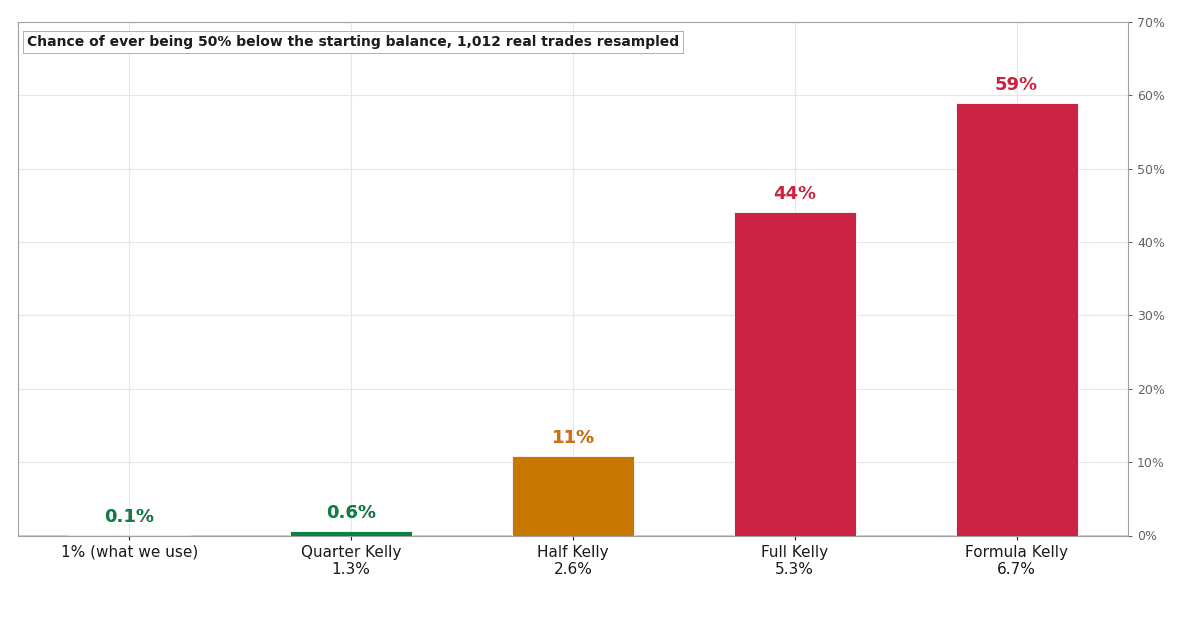
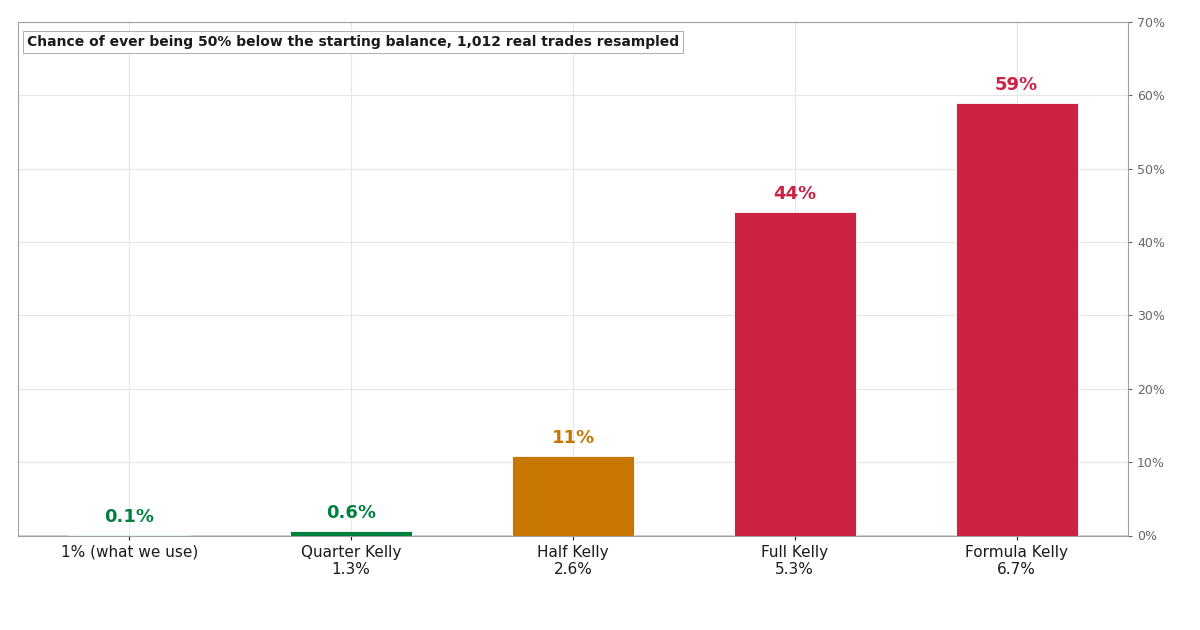 Chance of ever being 50% below the starting balance at each risk size
| Risk per trade | Typical result after 1,012 trades | Unlucky result (1 in 20) | Ever 20% below the start | Ever 50% below the start |
|---|---|---|---|---|
| 1% (what we use) | 1.9 times the account | about break-even | 11% | 0.1% |
| 1.3% (quarter Kelly) | 2.2 times | about break-even | 20% | 0.6% |
| 2.6% (half Kelly) | 3.9 times | lose 21% | 49% | 11% |
| 5.3% (full Kelly) | 6.0 times | lose 74% | 76% | 44% |
| 6.7% (the formula) | 5.3 times | lose 90% | 84% | 59% |
A few things stand out.
- Full Kelly does grow fastest. The typical result is six times the account, against under two times at 1%.
- The price is a ride most people could not sit through. At full Kelly there was a 44% chance of the account being worth half its starting balance at some point. A 50% fall from the account's own high was almost certain.
- The formula's 6.7% is worse on both counts. It grows more slowly than 5.3% and fails more often, because it is past the point where bigger bets stop helping.
- Half Kelly keeps most of the growth. It earns about 76% of full Kelly's long-run growth rate, with a quarter of the chance of halving the account.
The real problem: you do not know your Kelly
Everything above assumes the 1,012 trades show the strategy's true edge. They are only a sample. To see how much the answer depends on luck, we rebuilt the trade list 4,000 times by drawing trades at random from it, and worked out Kelly again each time.
The answer moved a lot. In 90% of the rebuilt lists, Kelly came out anywhere between 0.5% and 10%. In about 3% of them, the edge vanished and Kelly said to risk nothing.
Measured on just the first 250 trades, Kelly said 9.8%. A trader who sized from that early sample would have been risking almost twice the full-sample figure, and Kelly is unforgiving above its optimum: growth falls and the drawdowns get much deeper.
This is the strongest reason to bet well below Kelly. The number you calculate is an estimate with wide error bars, and the cost of guessing too high is far bigger than the cost of guessing too low.
Why we risk 1%
At 1% risk, this strategy has an 11% chance of the account ever being 20% below where it started over four years, and a 0.1% chance of halving. It grows more slowly than Kelly would, but the bad outcomes are survivable, and it leaves room for the real edge being smaller than the backtest says.
1% is about a fifth of the Kelly number here. A fraction like that is a common rule of thumb, and these trades show why it holds up.
How to use this on your own strategy
- Get your win rate, average win and average loss from at least a few hundred trades, and put them into the Kelly criterion calculator.
- Treat the answer as a ceiling, not a target. If your wins vary a lot in size, the true figure is lower.
- Start from a quarter to a half of it, then check what that size does to your drawdowns with the risk of ruin calculator, or by resampling your own trades in the Monte Carlo simulator.
- Turn the percentage into a lot size with the position size calculator.
Case 011 in one PDF: the exact rules, how we tested them, and what we found. Your email unlocks it and the other 11 case files, plus every new one as it lands.
Run the numbers yourself
The free calculators behind the sizing and robustness checks in this test. No signup.