Reddit's +188% Gold Breakout Lost 76% to 97% on 2019 to 2021 Data
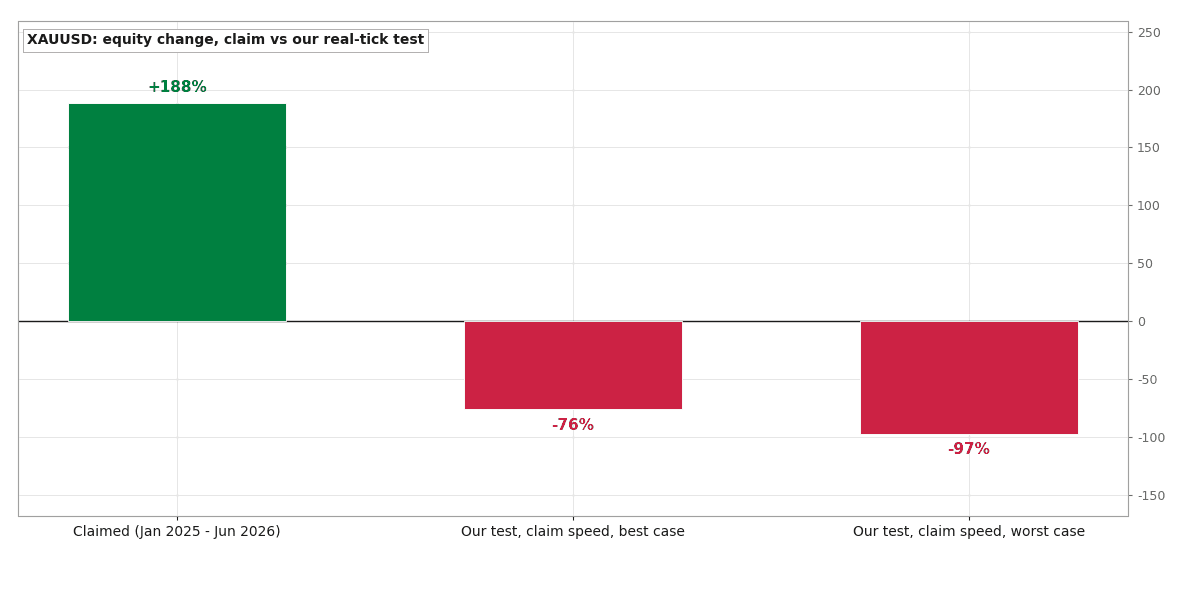
A gold breakout system on r/algotrading showed +188% in 18 months, with a profit factor of 1.74. Its author asked if it holds up outside that window. We ran it on 2019 to 2021 real-tick data with full costs. At its own speed of about three trades a day, every matching setting lost 76% to 97% of the account.
Does the Stairway to Heaven gold breakout strategy work outside 2025?
Not on our data. The Reddit post showed +188% from January 2025 to June 2026. We tested the same kind of system on 2019 to 2021 gold tick data with spread, commission and overnight swap. At its own speed of about three trades a day it lost 76% to 97% of the account. The best of 30 settings made +0.8% a year, trading five times slower.
The post
In July 2026 a trader posted a gold system on r/algotrading and called it "Stairway to Heaven". The idea is simple:
- Buy when gold touches the high of the last few bars. Sell when it touches the low (a Donchian breakout).
- One fixed trailing stop. That stop is the only way out of a trade.
- One position at a time, both directions, no grid, no martingale.
His backtest, January 2025 to June 2026, real ticks:
- +188% on a $10,000 start
- 1,136 trades, about three a day
- win rate 31%, average win $126, average loss $33
- profit factor 1.74, Sharpe 2.89, max drawdown about 21.41%
What made the post worth testing was the author himself. He listed his own doubts: one market, one period, mostly long trades, slippage not tested. And he asked whether it would hold up anywhere else. So this is our answer to his question. We are not saying his numbers are wrong.
How we tested it
The post gives the idea but not every setting. We filled the gaps and wrote each choice down before we ran anything:
- Chart: 15-minute bars. Three trades a day on a one-position system points there.
- Channel length: unknown, so we tried 16 to 96 bars.
- Trailing stop: unknown, so we tried $3 to $15 per ounce.
- Entry: on the touch, inside the bar, like a stop order. Not on the candle close.
- Exit: only the trail. No profit target, no time limit.
- Costs: real spread from the tick data ($0.46 to $0.88 per ounce for a round trip), commission of $3.50 per side per lot, and the broker's overnight swap. Holding gold long overnight costs about $62.6 per lot per night, three times that on Wednesdays. The post never mentions swap.
- Sizing: 1% of the account per trade. His averages suggest he risked about a third of that. Profit factor and win rate don't depend on sizing. Drawdown percentages do, so compare those with care.
Six channel lengths times five stop sizes makes 30 settings. We ran all of them on 2019 to 2021, the older years we use to build and judge a system. His 2025 window sits inside our newer, held-back years. We never opened it, because the system did not pass the first stage.
One method note for anyone backtesting something similar. On the same month and the same settings, MT5's simulated-tick modes gave a profit factor of 0.084 and 0.055. Real ticks gave 0.962. A trail that moves on every tick cannot be judged on made-up ticks. Every number below comes from real ticks.
What came out
26 of the 30 settings lost money.
The settings that trade like his system, with a $3 to $6 trail, made two to 3.4 trades a day. Every one of them lost 76% to 97% of the account.
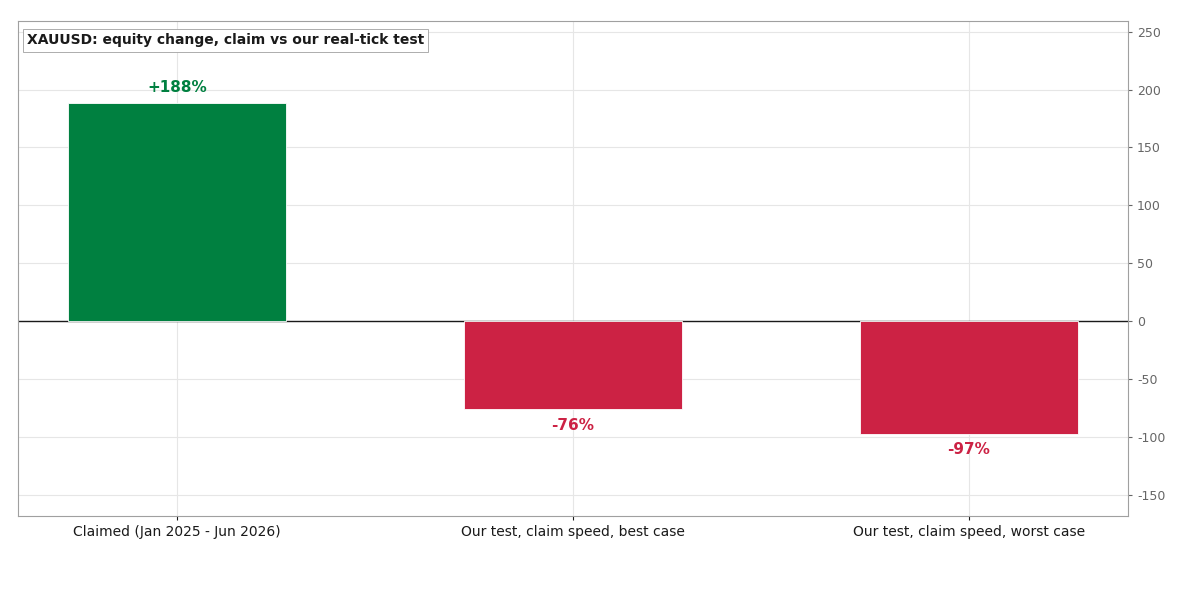 His claimed result next to our test at the same trading speed. Note the different windows: his is January 2025 to June 2026, ours is 2019 to 2021.
The best result of all 30 came from the slowest corner: a 96-bar channel and a $12 trail. It made 684 trades over three years and finished +$254.70. That is a profit factor of 1.01, a win rate of 36.3%, a max drawdown of 20.79%, and about +0.8% a year. It also trades only 0.5 to 0.6 times a day. That is a different system from the one in the post.
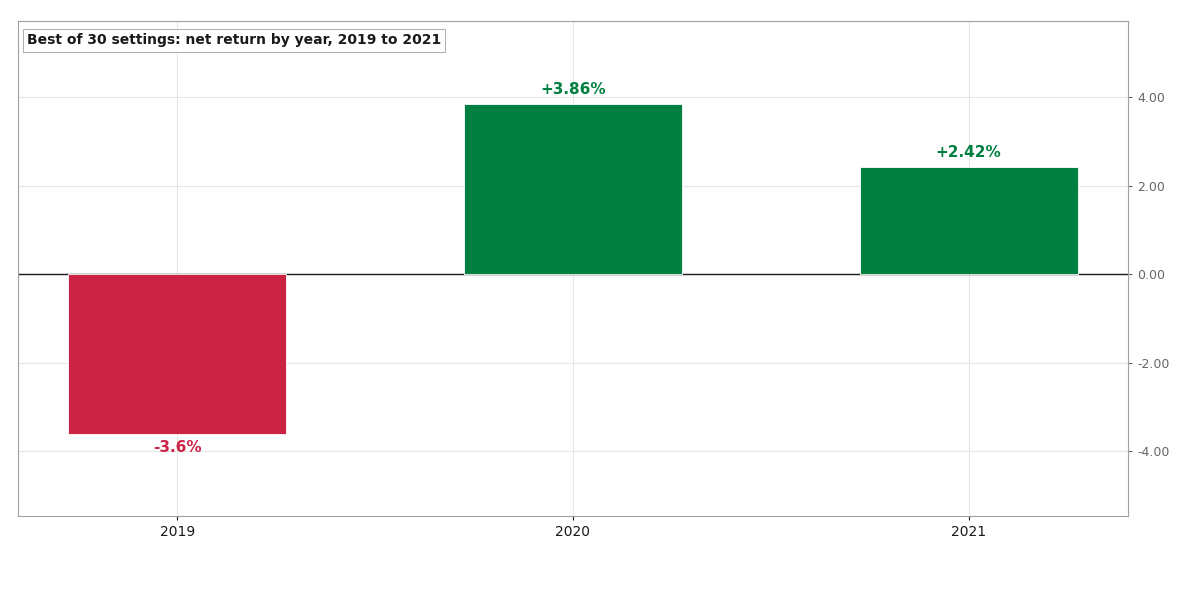 The best of the 30 settings, year by year. Swap cost it $325.64 over the three years and commission $369.32.
Its neighbours lost money, so this was a lucky corner, not a stable area. Our selection step found zero settings with a profitable neighbourhood.
Why it fails
Three things eat it.
The spread, thousands of times. At about three trades a day the system pays the gold spread plus commission somewhere around 1,800 to 2,700 times in three years. Each payment is small. Together they are the whole edge.
The trail caps the winners. A fixed $3 to $6 trail on gold is fakeout sized. In the choppy 2019 to 2021 market it kept the winners small, too small to pay for all the losers.
Swap taxes the good trades. The trades that do catch a trend stay open for days. Every night long costs about $0.63 per ounce, and Wednesday costs three times that.
So where did +188% come from?
We think the answer is the period. Gold went up hard in 2025, and a long-biased breakout with a trail rides that kind of market well. In a market that goes sideways, the same rules pay the spread on every fake breakout.
We wrote that guess down before running any test, and the data agreed. The results also got better every time the system got slower, in both channel length and stop size. That points toward daily-chart trend following. Our earlier gold chandelier test found the same direction.
Verdict
Rejected at the first stage. At the speed the post describes, this gold breakout has no edge on 2019 to 2021 data once you pay spread, commission and swap. His 18 months may well be real. They just don't show that the system works outside that market.
If you run something like this yourself, test it on years where gold went nowhere, and charge it the overnight swap.
Which strategy should we test next?
The exact rules of every strategy we've put on trial, how we tested each one, and what the data showed. 12 case files so far, free with your email.
Run the numbers yourself
The free calculators behind the sizing and robustness checks in this test. No signup.