We Faded Gold's London PM Fix, 2019-2021. Bigger Moves Lost More.
Currency prices bounce back a little after the 4pm London fix. Gold has its own fix at 15:00 London, so we checked whether the same fade works there. On 2019 to 2021 one-minute data, before writing any code, the best of 9 setups made $0.049 an ounce before costs. One trade costs $0.27. The bigger the move into the fix, the worse fading it did.
Does gold reverse after the London PM fix?
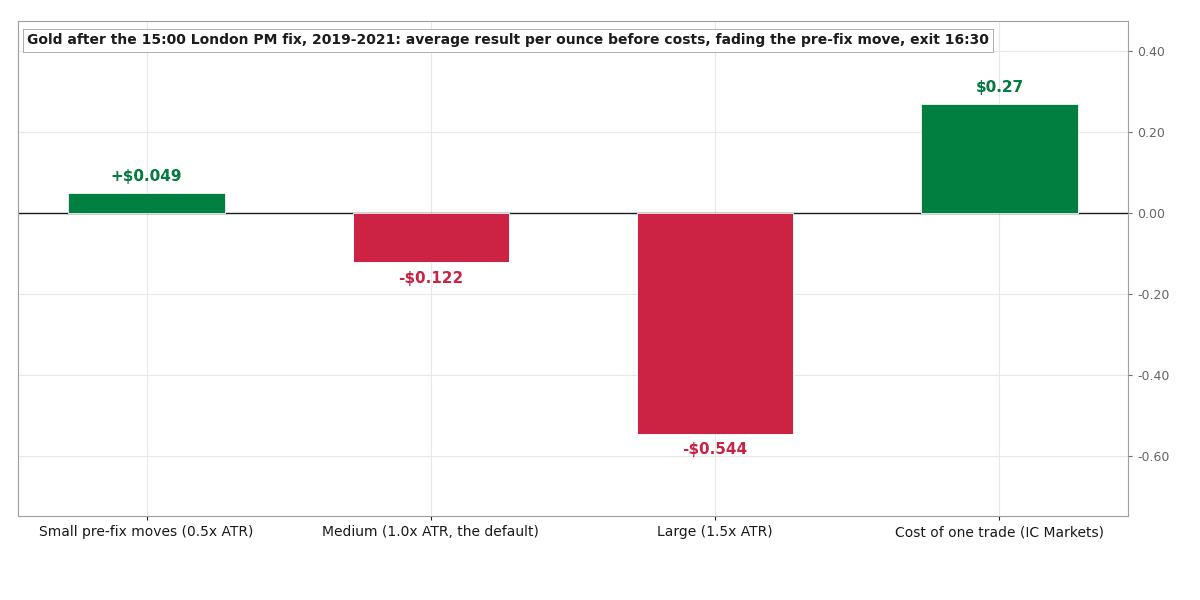
Not enough to trade, on 2019 to 2021 data. Fading the move into the 15:00 London fix made $0.049 an ounce before costs in the best of 9 setups, against $0.27 of cost per trade. The default setup lost $0.122 an ounce before costs, and fading the biggest moves lost $0.544.
The Backtest Files: the exact rules of each strategy we've put on trial, how we tested it and what the data showed. Free with your email.
The idea: take a fix trade that works and move it to gold
A fix is a moment when a benchmark price gets set. Funds and companies that have to trade "at the fix" send their orders in and accept whatever price comes out.
We have already tested one of these on currencies. Around the 4pm London currency fix, a big move into the fix tends to give a little of itself back afterwards. On GBP/USD that fade made money on years it never saw. It paid very little, but it was there.
Gold has its own fix. The LBMA gold price is set by auction twice a day in London, and the afternoon one runs at 15:00 London time. The thinking is that gold ETFs, miners hedging their output, central banks and jewellers trade at or into that price.
So the idea was simple. If those orders push gold one way in the two hours before 15:00, the push should stop once the auction clears, and the price should drift partly back. We had never tested it on gold, and we wanted to know before building anything.
What we measured
- Market: gold (XAU/USD), Dukascopy one-minute data.
- Period: 1 January 2019 to 31 December 2021, 774 London business days we could measure. These are our in-sample years, the ones we use to check ideas. We read nothing from 2022 onwards.
- The clock: London time, with the UK's own daylight-saving dates. Days with no auction (UK bank holidays) are skipped.
- The move into the fix: gold's change from 13:00 to 15:00 London.
- The trade: if that move was bigger than a set size, go the other way at 15:05, after the auction's first round. A rise gets a short, a fall gets a long. One trade a day at most.
- "A set size": 0.5, 1.0 or 1.5 times gold's average hourly range over the last 14 hours. So only days with a real push into the fix count.
- The exit: a fixed time, 16:00, 16:30 or 17:00 London. A stop at 2 times the average hourly range. No profit target.
- The cost of one trade: $0.27 an ounce at IC Markets ($0.20 of spread plus $0.07 of commission). Gold held for two hours pays no overnight fee.
Three sizes times three exits makes 9 setups. All 9 were set before we looked at any data. The default was 1.0 times the hourly range with a 16:30 exit. Our rule: if the move before costs doesn't beat the cost, we stop there.
The result: the bigger the push, the worse the fade
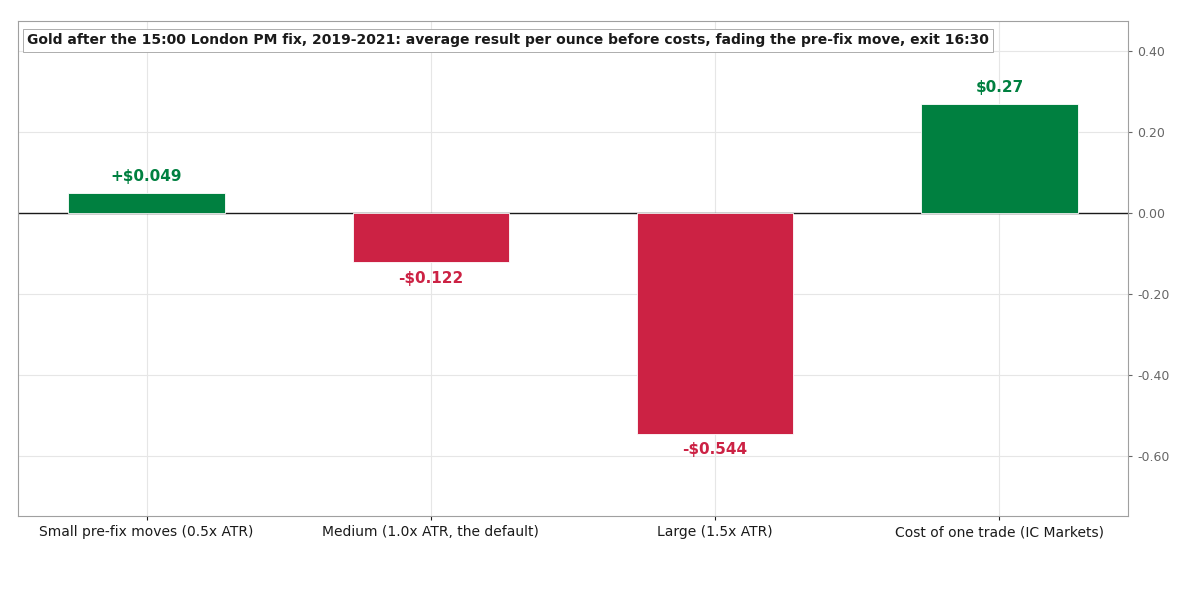 Gold after the 15:00 London PM fix, 2019 to 2021: average result per ounce before costs when fading the move into the fix, exit 16:30, by how big the move had to be. The last bar is the cost of one trade.
With the 16:30 exit, before any costs:
| Move into the fix | Trades | Average per ounce | Share of the cost |
|---|---|---|---|
| Small (0.5x the hourly range) | 567 | +$0.049 | 0.18x |
| Medium (1.0x, the default) | 406 | -$0.122 | -0.45x |
| Large (1.5x) | 290 | -$0.544 | -2.01x |
The default setup lost $0.122 an ounce on average before costs. A second, separate script that shares no code with the first got the same figure, -$0.1221, on the same 406 trades.
The best of all 9 setups was the small-move one with the 16:30 exit: +$0.049 an ounce. That is 0.18x the $0.27 a trade costs. You would pay about five and a half times more to the broker than the setup made.
The pattern is the opposite of the idea. If fix orders push gold and then stop, the biggest pushes should snap back the most. Here the biggest pushes did the worst. Fading moves of 1.5 times the hourly range lost between $0.25 and $0.54 an ounce before costs, depending on the exit. On these years, a big move into the gold fix tended to carry on after it, not reverse.
Neither direction saved it. In the default setup, the longs (buying after a fall into the fix) averaged -$0.22 an ounce, and the shorts -$0.03.
One good year out of three
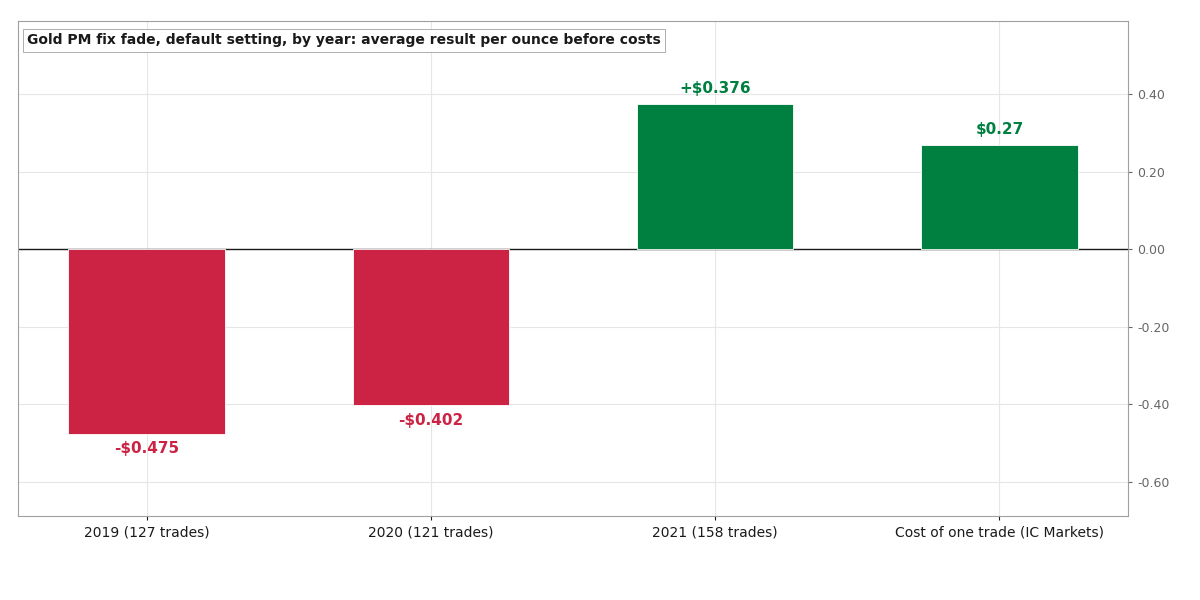 Gold PM fix fade, default setup (1.0x the hourly range, 16:30 exit), by year: average result per ounce before costs. The last bar is the cost of one trade.
| Year | Trades | Average per ounce, before costs |
|---|---|---|
| 2019 | 127 | -$0.475 |
| 2020 | 121 | -$0.402 |
| 2021 | 158 | +$0.376 |
2021 is the honest part of this story. That year the fade worked, and in the default setup it made $0.376 an ounce before costs, more than the $0.27 cost. 2021 came out positive in every one of the 9 setups.
But it is one year out of three. 2019 and 2020 lost more than 2021 made, in the default setup. A trade that pays in one year and loses in the other two isn't an edge you can plan around. You would need to know in advance which kind of year you are in.
What this means
The currency fix fade and the gold fix fade sound like the same trade. On our data they did not behave the same. After the London currency fix, part of a big move comes back. After the London gold fix, from 2019 to 2021, it mostly did not, and the bigger the move, the less it did.
None of the 9 setups covered its cost. So we stopped here, before writing a robot.
The limits of this test
- Three years, 2019 to 2021. We did not test 2022 onwards, because the idea failed on the earlier years.
- We used IC Markets' typical gold spread for the cost. The data vendor's own spread at 15:05 was wider, so on that spread every setup does worse.
- The figures are averages before costs. None of the 9 is far enough from zero to tell a small real effect from no effect.
- We tested the afternoon fix only, and only fades. Gold's morning fix, and trading with the move instead of against it, were not part of this test.
Which strategy should we test next? Tell us in the comments on our videos, or send it through the contact page.
The exact rules of every strategy we've put on trial, how we tested each one, and what the data showed. 27 case files so far, free with your email.
Send us your rules or your MT5 EA. We run them through the same tests as this post, with real broker costs and data the strategy has never seen, and give you a plain verdict.
Run the numbers yourself
The free calculators behind the sizing and robustness checks in this test. No signup.