Buying Gold's Sharp Dips Paid All of 2025. Then 2026 Lost Money.
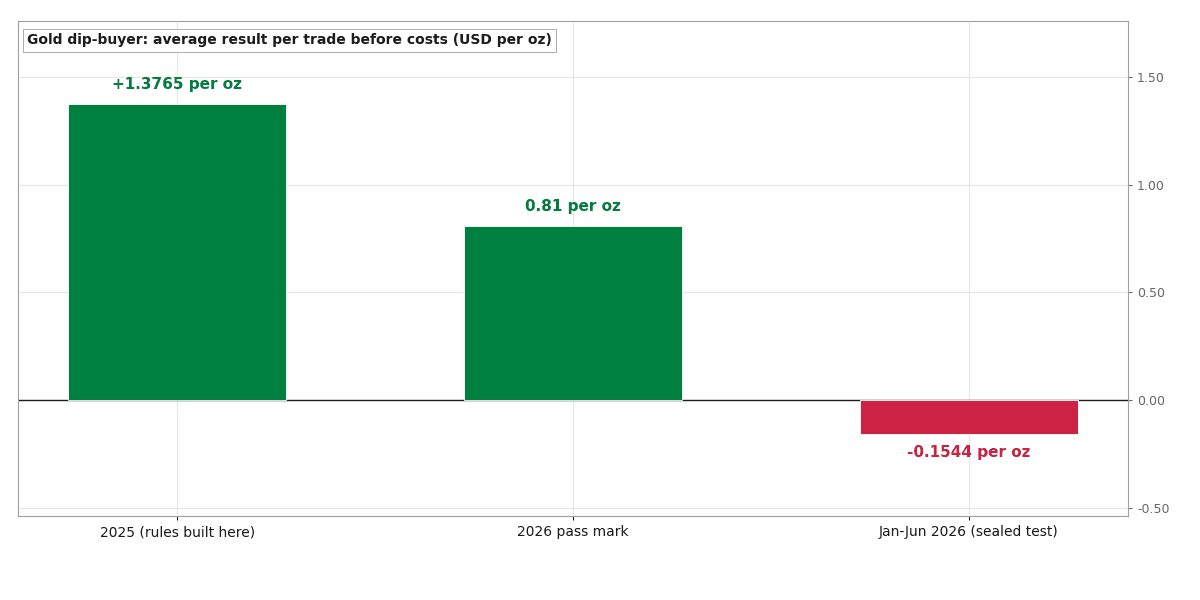
Two buy-the-dip rules for gold made money on 167 trades in 2025. We froze them and ran them once on January to June 2026. They averaged -0.1544 per ounce per trade before costs, and two trades were carrying the rest.
Does buying sharp intraday dips in gold still work in 2026?
Not in our test. Two long-only dip rules made +1.3765 per ounce per trade before costs over 167 trades in 2025, about 5.1 times the 0.27 cost. Frozen and run once on January to June 2026, the same rules averaged -0.1544 per ounce over 74 trades, against a pass mark of 0.81. The London afternoon leg lost -6.6843 per trade, and the spike leg's typical trade lost -6.78. We rejected it.
The Backtest Files: the exact rules of each strategy we've put on trial, how we tested it and what the data showed. Free with your email.
The idea
In a gold bull market, buy the dip. Gold has been rising on central-bank and ETF buying, and in a market like that a sharp sell-off inside the day is often stop-losses and forced selling, not a change of mind. If that is true, gold should win back part of the drop within an hour or two, and buying the drop should pay.
We didn't take this from a guru. It came out of our own search through 2025 gold data, where the buying side of two ideas we were testing kept making money. We joined them into one long-only strategy. That part matters: we picked these rules after seeing 2025. So 2025 can't prove anything. The real test was the first half of 2026, which we kept sealed and opened once.
The two rules
Both rules only buy. One trade at a time, and a signal that fires while a trade is open is ignored.
- The spike buy. A 15-minute bar falls, its range is at least 3 times the average range of the last 96 bars (the last 24 hours), and it closes in the bottom quarter of that range. Between 07:00 and 19:00 UTC, buy at the close of that bar, sell 60 minutes later. Stop loss at 2 times the average range.
- The afternoon fix buy. Gold is priced in a London auction every afternoon at 15:00 London time. If gold fell by at least half its average hourly range between 13:00 and 15:00 London, buy at 15:05 and sell at 16:30 London. Stop loss at 2 times the average hourly range.
Market and data: gold (XAUUSD), Dukascopy prices on the UTC clock. Costs: 0.27 per ounce per round trip, spread plus commission. All figures below are per ounce, per trade, before costs unless we say "after costs".
The bar for 2026, written down before any 2026 price was read: the average trade must make at least 0.81 per ounce before costs (3 times the cost), and it must beat buying at random times in the same windows.
What came out
 Average result per trade before costs: 2025, the 2026 pass mark, and January to June 2026
2025, the year the rules came from: 167 trades, +1.3765 per ounce per trade, 5.1 times the cost. 55.7% of trades won. Both rules made money: the spike buy +1.2262 over 89 trades, the fix buy +1.5479 over 78. After costs, the year added up to +184.78 per ounce.
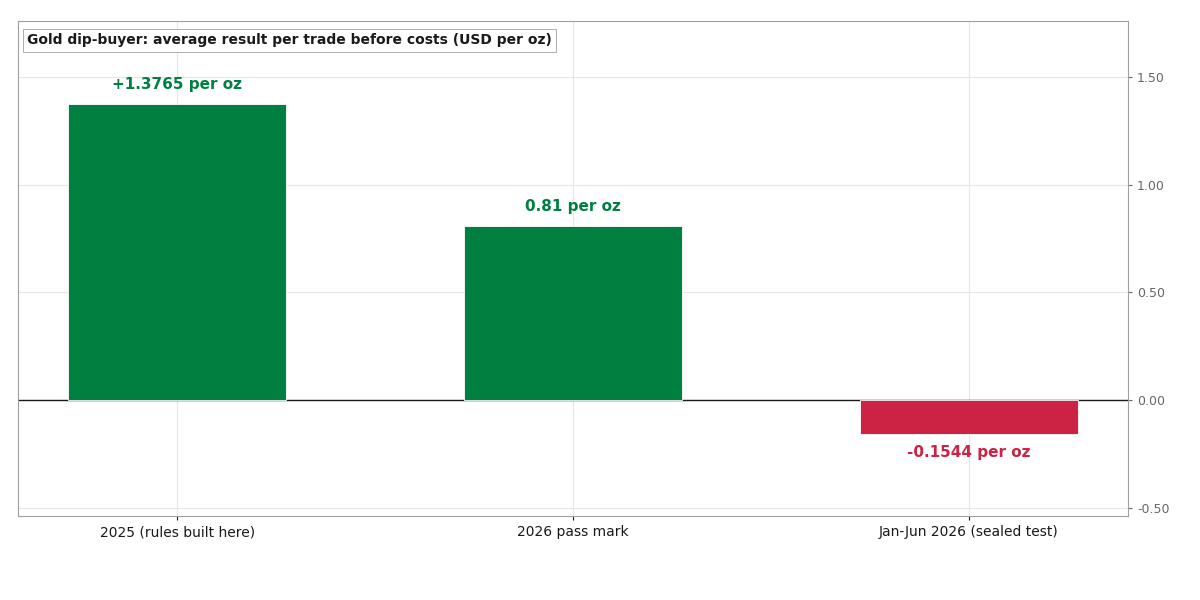
January to June 2026, the sealed test: 74 trades, -0.1544 per ounce per trade. 47.3% of trades won and 24 hit their stop. After costs the six months added up to -31.4 per ounce. The pass mark was 0.81, so we rejected it.
One part of the bar did pass, and it's fair to say so. Buying at random times in the same windows did even worse in 2026, so the dip buys beat random entries by 1.8273 per trade. Losing less than a coin flip still loses, though.
Why it broke
The afternoon fix buy was never really a dip buy. In 2025, buying gold at 15:05 London and selling at 16:30 on every day made +1.6164 per trade on its own. The fix rule made +1.5479. So all it did in 2025 was hold gold during a window that went up all year. In 2026 that window turned: on every day it averaged -3.2407, and the fix buys made -6.6843 per trade over 37 trades.
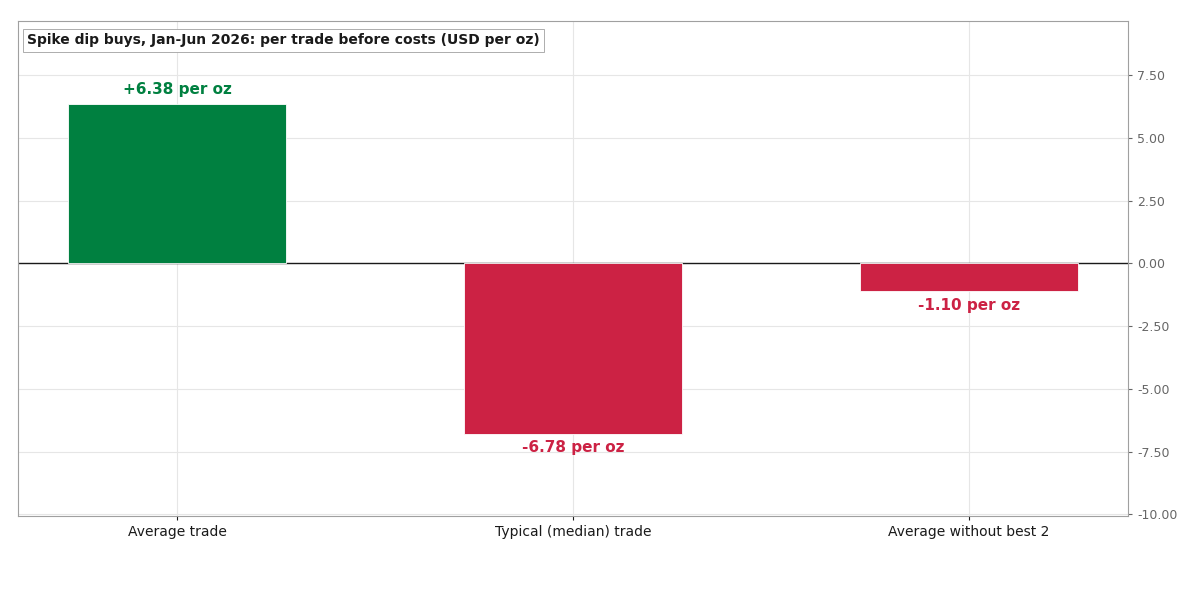
The spike buy looked fine on average, and the average was lying.
 Spike dip buys, January to June 2026: average trade, typical trade, and average without the best two
Its 37 trades in 2026 averaged +6.38 per trade. But the typical trade, the median, lost -6.78. Only 43% won, and 17 of the 37 hit their stop. Two trades made the average: +151.2 on 29 January and +123.2 on 23 March, both rebounds after a crash. Take those two out and the rest averaged -1.10.
29 January shows both rules in one afternoon. The fix buy at 15:05 London was stopped out for -121.29 per ounce. Forty minutes later the spike rule bought the next leg down and made +151.23. You can't plan for a day like that, and a strategy that needs one is a bet on crashes, not on dips.
We checked the spike buy on 2024 too
Dropping the fix buy and keeping only the spike buy would look good on 2026's average. But choosing that now would mean choosing from the sealed test, and that test is already spent. So we ran the spike rule, unchanged, on 2024, a year it had never been tested on. The pass mark was written first.
- 108 trades, average -0.0129 per trade before costs (pass mark 0.81)
- Typical trade -1.85, 41.7% winners, 51 stops
- Without its best two trades, -0.45
- Buying at random times in the same window made +0.05
Across three periods, the spike buy was flat in 2024, positive in 2025 (+1.23 per trade, typical trade +2.28), and in 2026 lived on two crash days. Only 2025 shows an edge on the typical trade.
What we did not do
We didn't tune the rules after 2026. No new stop, no new window, no dropping the losing leg. Any of those would fit the rules to the six months that were meant to judge them. The only clean test left is a live demo account with a loss limit set in advance, and we haven't run one.
This is a test of two fixed rules on one market. It says nothing about buying dips over days or weeks.
The lesson
Before you trust a dip rule, check the median trade. An average can be two lucky days. If the typical trade loses and a couple of crash rebounds pay for everything, you don't have a dip-buying edge. You have a lottery ticket with a stop loss.
Which strategy should we test next? You can see every strategy we tested, winners and losers, on the results page. We tested other gold ideas too, like the gold 50-day trend rule and the gold overnight bias.
Past performance does not mean future results. This is a backtest with real trading costs. It is not a live trading result.
The exact rules of every strategy we've put on trial, how we tested each one, and what the data showed. 27 case files so far, free with your email.
Send us your rules or your MT5 EA. We run them through the same tests as this post, with real broker costs and data the strategy has never seen, and give you a plain verdict.
Run the numbers yourself
The free calculators behind the sizing and robustness checks in this test. No signup.