Gold Really Does Rise Overnight. We Couldn't Keep a Cent of It.
The 'London bias' says gold makes its gains between the PM fix and the next AM fix. We checked it on raw tick data and it is true: +$0.90 per ounce per night. Then we tried to trade it. The costs were $1.47 per night.
Does gold really rise overnight, and can you trade it?
Yes, it rises, but you cannot keep the profit. From the PM fix to the next AM fix, in 2019 to 2021, gold rose about $0.90 per ounce per night. The spread and the overnight swap cost about $1.47. So all 36 settings we tested lost money.
The idea
There is a very old claim about gold. Some people on the internet believe the gold price is controlled. They say gold rises at night and stays flat or falls during the London and New York day.
Forget the conspiracy part. There is still a claim we can test:
- Buy at the London PM fix (3pm London time). The fix is the official gold price set each day.
- Sell at the AM fix the next morning (10:30am).
- If the claim is true, you get most of gold's long-term rise, and you skip the day session completely.
There is some support for this. A study of 54 years of fix prices shows the pattern. Academic research also found steady downward pressure on the price into the PM fix in the years 2004-2013. That research later helped lawsuits about fix manipulation.
We planned this as a test of what is left of the effect today. We did the same in our London fix study. The strongest evidence is from before 2015, when the fixing process was reformed. Our data starts in 2019. So from day one, we knew the answer could be "no".
The effect is real
First we measured the raw effect, directly from the 1-minute price data. No stop loss, no position sizing, no strategy. Just the price.
From 2019 to 2021:
- The overnight move (PM fix to next AM fix) added up to $692.72 per ounce over 774 nights.
- That is $0.90 per night, and 54.5% of nights went up.
- Gold rose $536 in total in the same period.
So the overnight hours made more than all of gold's total rise. This is exactly what the London bias claim says. The effect is real, and it is not small.
Then we built the EA (the trading robot) and ran a quick test:
- It buys at the PM fix, to the exact minute.
- It sells at the next AM fix. Trades open on Friday are held until Monday's AM fix.
- It pays the real swap (the fee for holding a trade overnight) on every night.
Everything worked as planned.
The costs are bigger than the profit
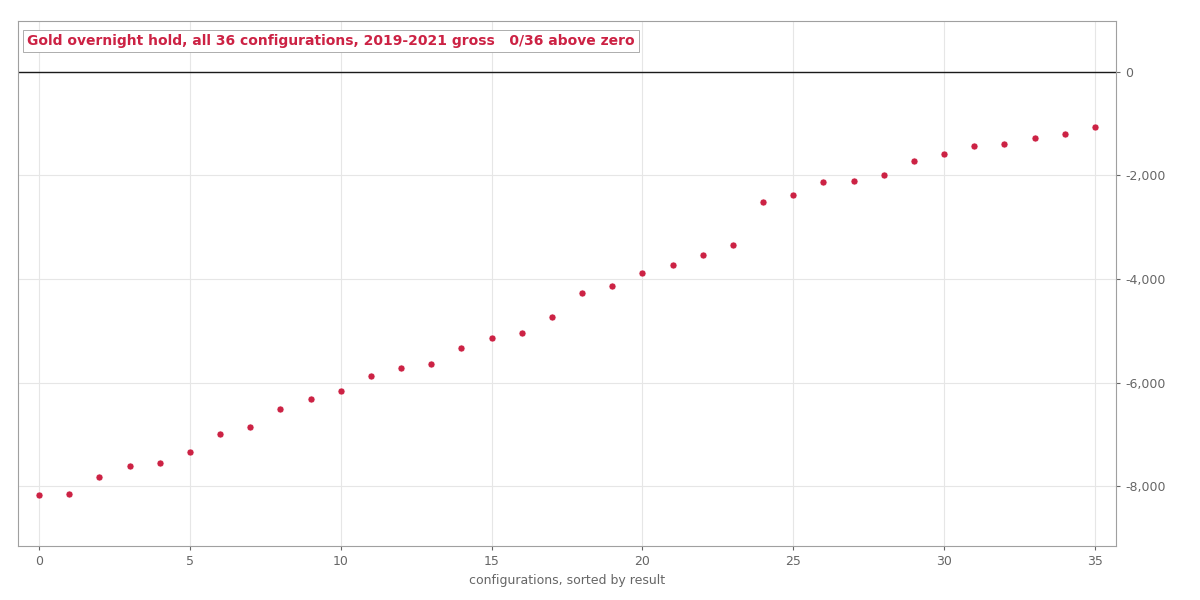
All 36 settings lost money, in two full rounds of tests.
- With stop losses from 2x to 4x the hourly ATR (the average size of an hourly price bar), the best setting lost $4,727. The worst lost $8,171.
- Then we made the stops very wide, 6x to 12x, so they would only hit in a disaster. The best setting improved to minus $1,065. Wider stops moved the results closer to zero, but never above it.
 The per-night arithmetic: the drift is real and the costs are bigger
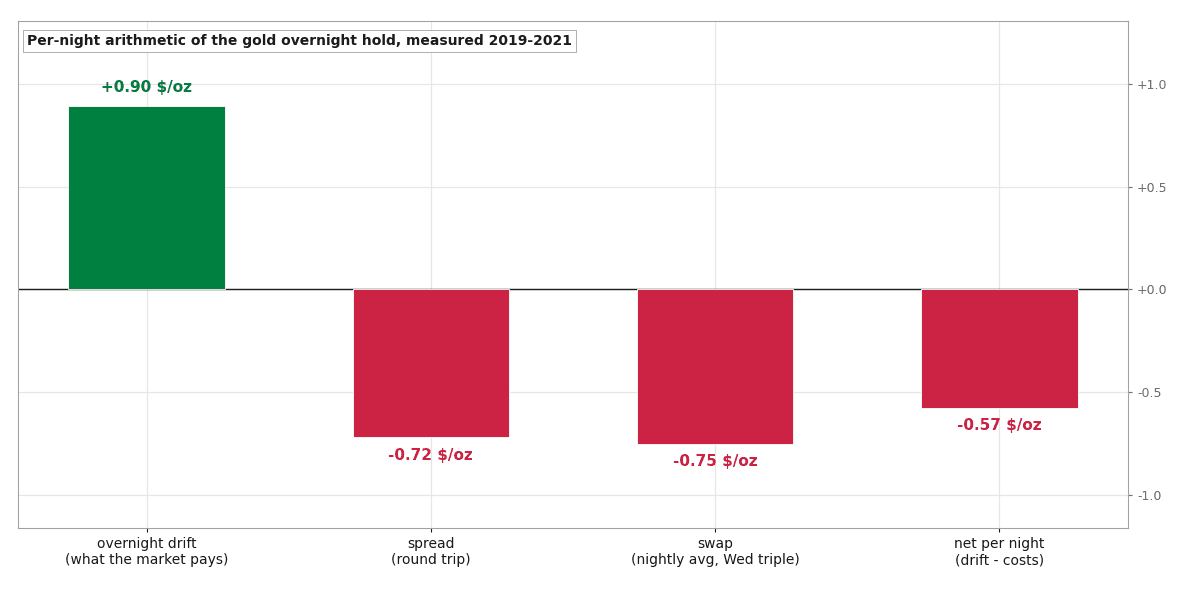
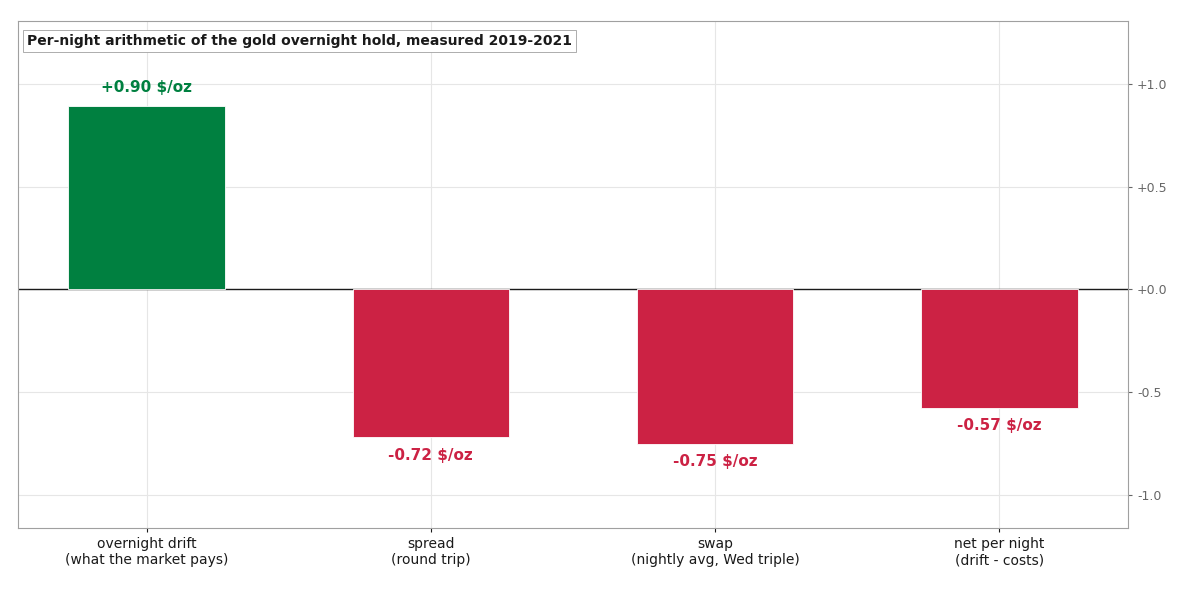
This chart explains the whole failure. Per ounce, per night:
- The market pays the overnight buyer $0.90.
- The spread for one buy and one sell through a CFD costs $0.72.
- The swap is $62.60 per lot per night for a buy trade, and three times that on Wednesdays. On average, that is about $0.75 per ounce.
- So the costs are about $1.47, and the profit is only $0.90.
No stop size, no change to the entry time, and no Friday filter can fix this simple subtraction. All 36 settings were going to lose before we ran them.
 All 36 configurations, gross, 2019-2021: nothing above zero
The effect also disappeared
There was a second problem, which is easier to miss. We split the results by year:
- 2019: $0.94 per night
- 2020: $1.74 per night
- 2021: $0.002 per night
The pattern behind the 54-year numbers faded to almost nothing inside our own test period. So even with zero costs, there was nothing left to collect by the end.
The opposite of our triple swap test
Some readers know our Wednesday triple-swap study. That test had the opposite problem. There, the swap income was real and arrived exactly as expected, to the cent. But the price moves destroyed the account. Here, the price move is real and we can measure it. But now we pay the swap instead of receiving it, and that destroys the trade.
Both studies teach the same rule. We now use it before we start any new research: if a strategy holds trades overnight by design, it must earn more than the spread plus the swap. We measure this first. Nothing else matters until it passes.
We did not use any out-of-sample tests (tests on new data the strategy was not built on) for this strategy. So our 2022-2026 data is still unused. The market really did pay $692 to overnight gold buyers in 2019-2021. But that money stays on the other side of the costs.
You can see all the strategies we tested, winners and losers, on the results page.
Past performance does not mean future results. These are backtests with real trading costs. They are not live trading results.
The exact rules of every strategy we've put on trial, how we tested each one, and what the data showed. 12 case files so far, free with your email.
Run the numbers yourself
The free calculators behind the sizing and robustness checks in this test. No signup.