We Reopened a Closed Case With Better Tools. The Case Stayed Closed.
We tested trading the London 4pm fix on the last days of each month, on four FX pairs together, with new portfolio tools we did not have before. The best setting over five years made 41 cents per trade.
Can you trade the month-end London 4pm fix?
Not with a profit on our data. We traded against the move before the 4pm fix on month-end days, on four FX pairs, for five years. Only 4 of 48 settings made money. The best one made 41 cents per trade.
What is the London 4pm fix?
Every day at 4pm London time, a benchmark price is set for each currency pair. It is called the WM/R fix. Many big funds use this price for their trades.
Around the fix, the price often moves in one direction because of these big orders. After the fix, the price often moves back. Trading against the move before the fix is called fading it.
Why we tested this idea again
We keep a list of ideas we rejected. We do not see it as a list of dead ideas. We see it as a list of ideas that may come back one day.
Two rows on that list were the same idea: trading around the London 4pm fix at the end of each month. Both times we rejected it for the same reason: too few trades. One pair has only twelve month-ends a year. That is never enough trades to pass our tests.
Both rows said what would change our mind: a way to put several pairs together and judge them as one set of trades.
We built that tool for our trend-following portfolio test. So this idea could come back. That is our rule: a rejected idea returns only when the reason we rejected it has really changed.
Why the end of the month?
There is good evidence for big orders at month-end:
- Funds that follow a benchmark, and companies that protect themselves from currency moves, rebalance at month-end. This means they buy and sell to get back to their target mix. They often trade at the WM/R fix price.
- BNY (a large bank) publishes a monthly model of these orders. Other banks sell month-end forecasts to their clients.
- Evans wrote the research paper behind our daily fix study. He found that the move back after the fix is strongest on exactly these days.
- Our own out-of-sample data (newer data we keep aside for a final check) agreed. The daily fix strategy had 19 month-end trades. They made half of all its profit in only 13% of its trades.
How we set up the test
We wrote down the full plan before any test:
- Fade the move before the fix on the last 1 to 3 business days of each month.
- Trade EURUSD, GBPUSD, USDJPY and EURJPY at the same time.
- Use one set of settings for all four pairs.
- Judge the result on all four pairs together, over five years of in-sample data (the older data we use to study an idea).
One thing we must say openly. For GBPUSD, the out-of-sample data is not fresh for this idea. We already studied and published the month-end trades from the daily study. The other three pairs were not used before.
The result: five years, four pairs, 41 cents
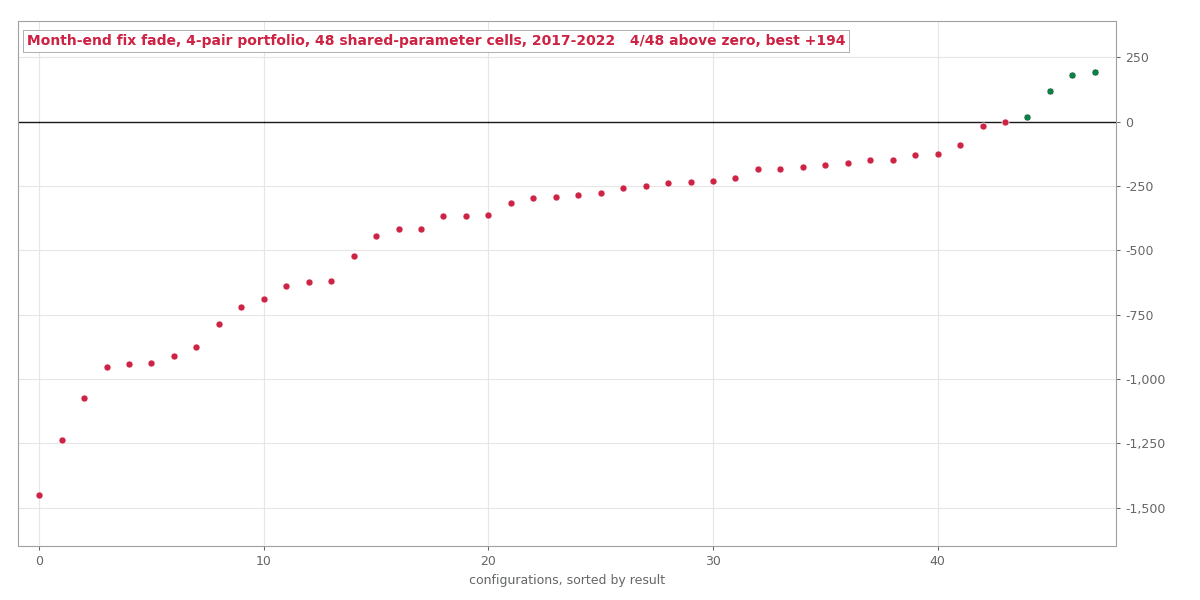
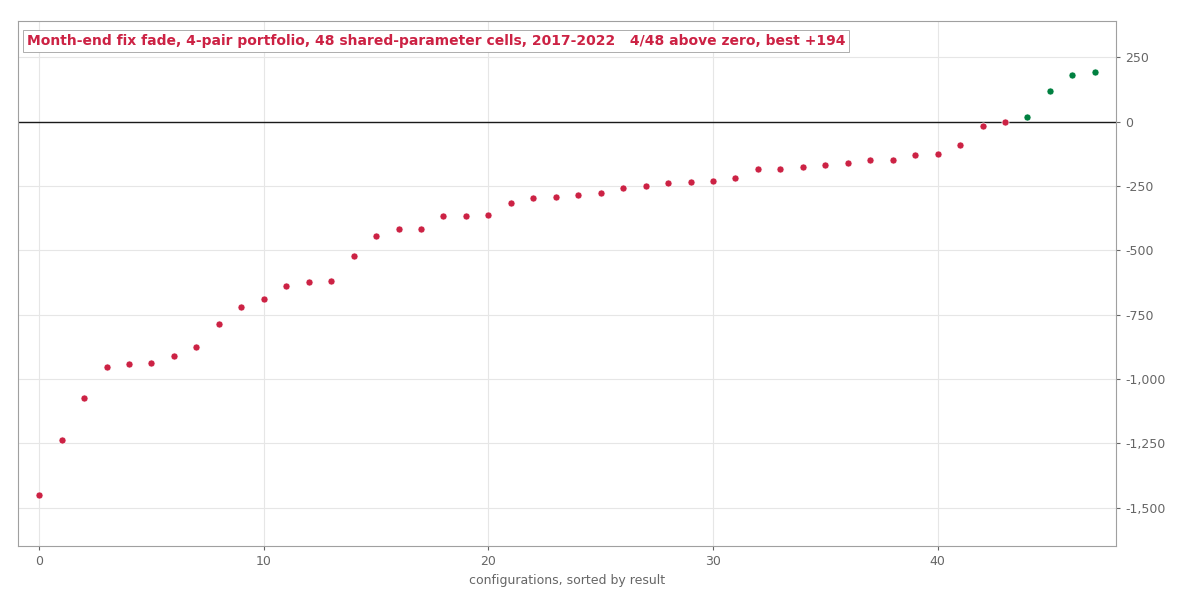 The 48 shared-parameter cells, summed across four pairs, 2017-2022
We tested 48 different settings. Only 4 made money.
The best one made $193.86 in 469 trades. That is five years, four currency pairs, and every month-end. And the best possible setting made 41 cents per trade.
You may remember this number. The best setting in our trend-following portfolio test also made exactly 41 cents per trade, and we rejected it too.
There were more problems:
- No setting made money on all four pairs.
- There was no group of nearby settings that all worked well. A good strategy usually has this.
We found one clear pattern. Trades held for 15 minutes did better than trades held for 30, 45 and 60 minutes. The longer the hold, the worse the result, in every part of the test. Research says the move back after the fix lasts 1 to 15 minutes. So our data agrees with the research about the timing. But the effect is too small to make money from.
The 19 month-end trades that gave us the idea now look like what they probably always were: a small sample that looked good by chance.
Closing the file
This was the third try for the fix idea in our research, and the best prepared one:
- The daily version made about 0.74% a year on GBPUSD. It failed our test for keeping enough of its return on new data.
- The month-end version, on four pairs and judged as one portfolio, makes less than one dollar per trade in sample.
In 2015, the rules for the fix changed. The time window for the fix price became longer. This change did what it was meant to do: it made the effect smaller. Our research rules now say this clearly: no more fix-fade ideas unless there is a truly new reason they should work.
We never used the out-of-sample data. Zero runs. The same rule that let us test the idea again also lets us close it cleanly. The blocker was removed, we asked the question properly, and the answer was no.
You can see all the strategies we tested, winners and losers, on the results page.
Past performance does not mean future results. These are backtests with real trading costs. They are not live trading results.
The exact rules of every strategy we've put on trial, how we tested each one, and what the data showed. 12 case files so far, free with your email.
Run the numbers yourself
The free calculators behind the sizing and robustness checks in this test. No signup.