Day Trading Statistics: What the Original Studies and Regulators Actually Found
Day trading statistics taken from the original studies and regulators, not from other blogs. How many day traders lose money, how many last, what costs do to them, and which popular numbers we could not trace.
What percentage of day traders lose money?
Most of them, in every large data set we found. In India, 71% of individual intraday traders lost money in FY23. In Brazil, 97% of those who kept going for 300 days or more lost money. In Taiwan, only about 13 to 15% made a profit after fees in a typical year, and under 1% did so consistently.
The Backtest Files: the exact rules of each strategy we've put on trial, how we tested it and what the data showed. Free with your email.
The short answer
Most day traders lose money. That holds in every large data set we could find. The exact share depends on the market, the years and who gets counted, so a single number like "95% fail" is not much use. These are the numbers from the people who hold the data:
| Market | Who was measured | Result | Source |
|---|---|---|---|
| India, stocks | Individual intraday traders, FY23 | 71% lost money | SEBI, 2024 |
| India, stocks | Same group, more than 500 trades a year | 80% lost money | SEBI, 2024 |
| Brazil, index futures | New day traders who kept going for 300 days or more | 97% lost money | Chague, De-Losso and Giovannetti |
| Taiwan, stocks | About 360,000 day traders in an average year, 1992 to 2006 | About 13 to 15% profited after fees in a typical year | Barber, Lee, Liu and Odean |
| Taiwan, stocks | Same group | Under 1% did well consistently | Barber, Lee, Liu and Odean |
How many day traders lose money
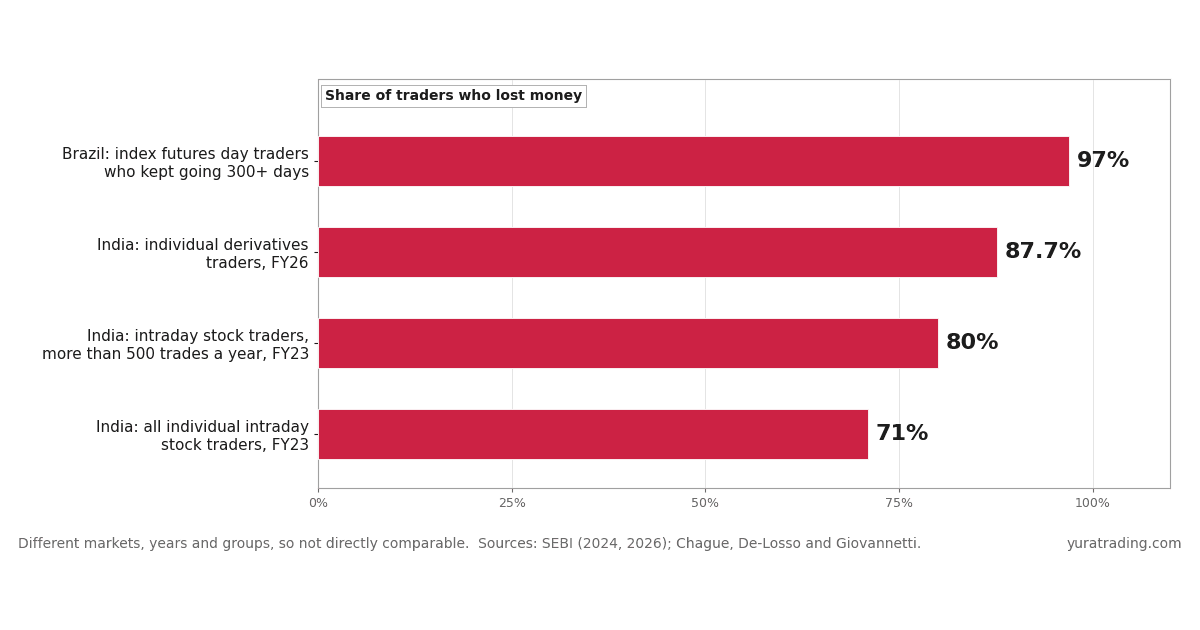
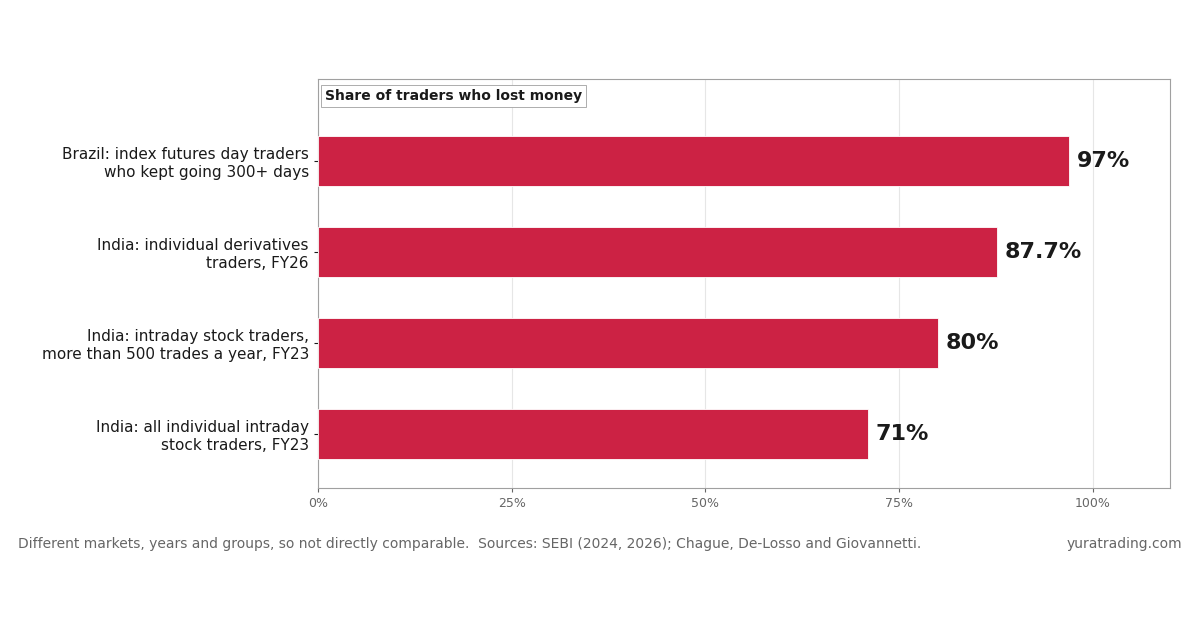 Share of traders who lost money: 97% of Brazilian index futures day traders who kept going 300 days or more, 87.7% of individual derivatives traders in India in FY26, 80% of Indian intraday stock traders making more than 500 trades a year in FY23, and 71% of all Indian individual intraday stock traders in FY23
India. The Securities and Exchange Board of India studied client records from the top 10 brokers. Its 2024 study found that the share of individual intraday traders who lost money rose from 65% in FY19 to 69% in FY22 and 71% in FY23. Traders under 30 did worse, at 76%.
Brazil. Chague, De-Losso and Giovannetti followed everyone who started day trading Brazilian index futures from 2013 to 2015. That was 19,646 people. Of the 1,551 who kept going for 300 days or more, 97% lost money and only 1.1% earned more than the Brazilian minimum wage. The authors found no evidence that traders got better with practice.
Taiwan. Barber, Lee, Liu and Odean used every trade on the Taiwan Stock Exchange from 1992 to 2006. In an average year about 360,000 people day traded. The paper gives both 13% and 15% for the share who made a profit after fees. Fewer than 1%, about 1,000 of the 360,000, did it consistently. So a few skilled traders do exist. There are just very few of them.
How long day traders last
Most stop within two years. Using the same Taiwan data, the October 2017 version of "Do Day Traders Rationally Learn About Their Ability?" says more than 75% of day traders quit within two years. For people who had day traded on at least 10 days:
| Time since starting | Still day trading |
|---|---|
| 1 year | 44% |
| 2 years | 24% |
| 3 years | 15% |
Losing did not make people stop as often as you might expect. Among traders with 50 or more days of experience, 95.3% of those who had been losing money day traded again within 12 months, against 96.4% of those who had been making money.
Brazil looks similar. Only 1,551 of the 19,646 starters, about 8%, kept going for 300 days or more.
What costs do to day traders
Costs are paid on every trade, win or lose, so frequent trading makes them worse.
- Loss-makers paid again on top of their losses. SEBI found that Indian intraday traders who lost money spent an extra 57% of their trading loss on costs in FY23. For those making more than 500 trades a year it was 72%.
- Frequent traders kept less. Barber and Odean studied 66,465 US households from 1991 to 1996. These were ordinary investors, not day traders. The ones who traded most earned 11.4% a year while the market returned 17.9%.
We see the same thing in our own tests. We ran 24 popular day-trading strategies with fixed rules, real spreads and commissions, and a test on data the rules had never seen. 14 had no reliable edge even before costs, 3 had a real edge that costs ate, 6 had a real edge too small to pass, and one passed every test. The full results are in Is Day Trading Worth It?
Leveraged products: options, CFDs and forex
These traders are not all day traders, but many short-term retail traders use these products, and regulators can see every account.
India, equity derivatives. SEBI's August 2026 study is the newest large data set we found. It covers about 90% of individual traders.
- 87.7% of individuals lost money in FY26, down from 90.9% in FY25.
- 91.0% lost money across FY25 and FY26 combined.
- Total net losses were ₹91,685 crore in FY26, down from ₹1,11,788 crore in FY25.
- 89% of traders under 30 lost money in FY26.
- Loss-makers lost ₹1.47 lakh on average. Profit-makers made ₹1.22 lakh.
Elsewhere. These figures come from the review table in that SEBI study. The EU figure we also checked against ESMA's own 2018 statement.
| Where | Product | Share who lost money | Original source |
|---|---|---|---|
| European Union | CFDs | 74 to 89% | ESMA (2018) |
| France | CFDs and forex | 89% | AMF (2014) |
| United Kingdom | CFDs | About 82% | FCA (2016) |
| Australia | CFDs | About 68% | ASIC Report 828 (2026) |
| United States | Retail forex | About 67% | CFTC disclosures |
| South Korea | KOSPI 200 futures | About 75% | Choe and Eom (2009) |
| United States | Day trading | About 67% | Jordan and Diltz (2003) |
Popular numbers we could not confirm
"95% of traders fail." None of the studies on this page reports that number, and we could not trace it to an original study. The real figures run from about 67% to 97%, depending on the group.
"40% quit within a month, 13% are left after three years, 7% after five." Websites usually credit this to the Taiwan research. The October 2017 version says something different: only 2.5% dropped out within one month, and 15% were left after three years. Its text gives no five-year figure. It does say about 42 to 43% of traders with 10 to 49 days of experience paused for at least a month, which may be where the 40% came from. An older draft may also have used other numbers.
Read these numbers with care
- They are not directly comparable. The markets, years and costs all differ. SEBI says the same about its own table.
- Lost money in a year is not the same as failed. The Indian intraday figures cover single years. In the same study, 54% of traders with at least three years of experience still lost money in FY23.
- The Brazil figure covers people who kept going. It is about the 1,551 who persisted, not all 19,646 who started.
- Some papers are older. The Taiwan data ends in 2006, and the versions linked here are the authors' own drafts.
Using these numbers
You are welcome to quote anything here. Please link to the original source for each number, and to this page if the list helped. If you find a mistake or a better source, tell us and we will fix it.
The exact rules of every strategy we've put on trial, how we tested each one, and what the data showed. 27 case files so far, free with your email.
Send us your rules or your MT5 EA. We run them through the same tests as this post, with real broker costs and data the strategy has never seen, and give you a plain verdict.
Run the numbers yourself
The free calculators behind the sizing and robustness checks in this test. No signup.