We Transferred an Academic Momentum Effect to EURUSD. The Market's Most Efficient Pair Said No.
Research shows intraday momentum in stocks and in RUB-USD. We tested it on EURUSD after 2019. The best of 48 settings made only $371 in three years. The idea failed on a new market, and trading costs were not the reason.
Does intraday momentum work on EUR/USD?
Not in our test. The best of 48 settings made $371 in three years of EUR/USD data from 2019, a profit factor of 1.09. Costs were not the problem: the spread is 0.1 to 0.3 pips, and the targets are 10 to 40 pips.
What is intraday momentum?
Intraday momentum means this: if price moves one way in the morning, it tends to keep moving the same way later that day.
Several research papers support this:
- In US stocks, the first half-hour of the day predicts the last half-hour (Gao, Han, Li, Zhou).
- The same effect shows up in markets around the world.
- In forex, Elaut, Frommel and Lampaert found it in RUB-USD tick data. They published it in the Journal of Financial Markets.
The researchers also give a reason for it. Big banks that provide prices (liquidity providers) do not like to hold positions overnight. So late in the day, their orders tend to push price in the same direction the day was already moving. This is a reason based on how the market works. It is not magic.
What we tested
We wanted to know if this still works on a major currency pair. So we built the simple version that traders normally use:
- Measure how far price has moved from the day's open at a fixed morning hour. We tested hours from 04:00 to 10:00 UTC.
- If the move is bigger than a set size (we tested 10 to 40 pips), trade in that direction.
- Close the trade at 21:00 UTC at the latest.
- Never hold a trade overnight. The reason for the effect is that everyone avoids holding overnight, so we avoid it too.
We chose EURUSD on purpose. Its spread (the cost to trade) is only 0.1 to 0.3 pips, and our targets are 10 to 40 pips. Of all the tests on our list, this is the one where trading costs cannot be the reason it fails.
Before the test, we wrote down that this was a transfer test: we were taking an idea from one market and trying it on another. The forex evidence in the research comes from a less common pair (an exotic pair), about ten years ago.
The results were empty
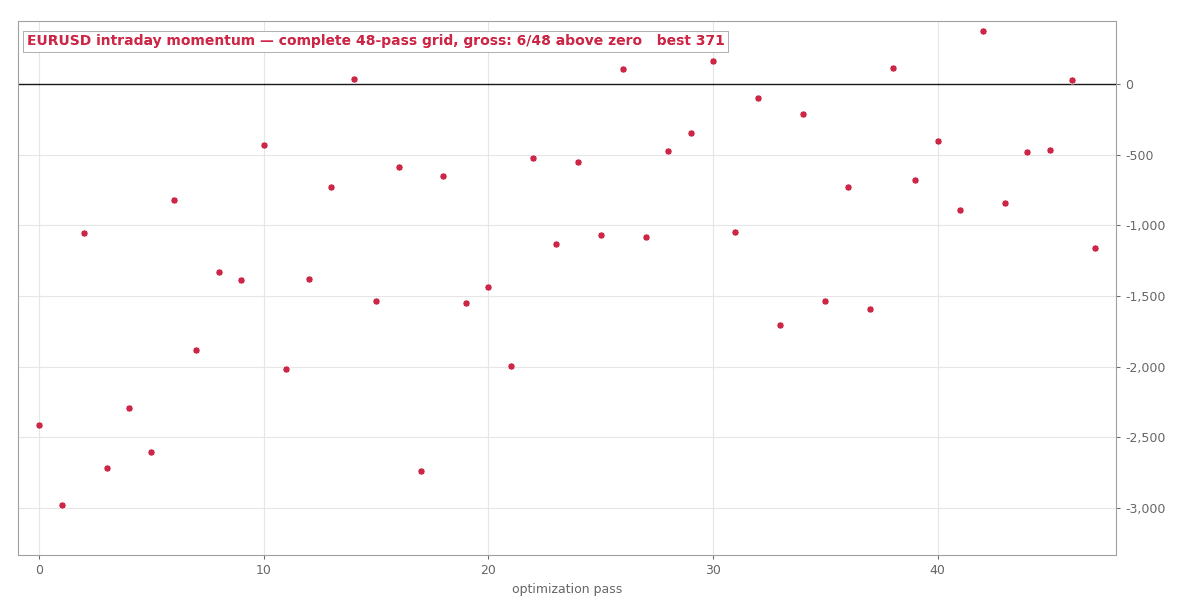
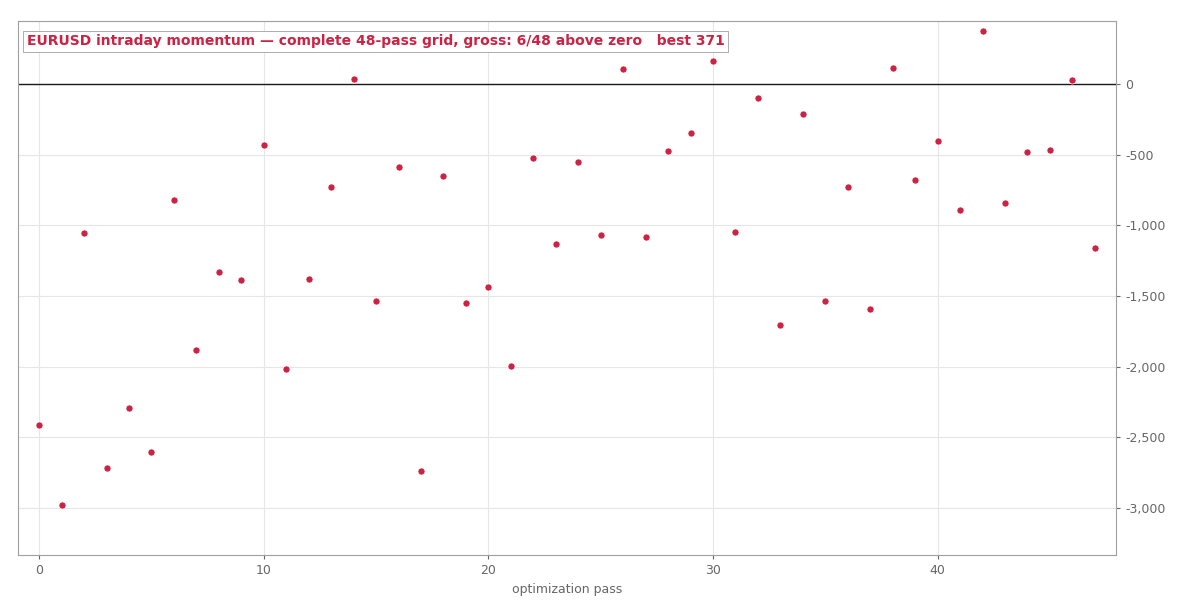 All 48 configurations, gross, 2019 to 2022. Six finished above zero; the best made $371 in three years.
We tested 48 combinations of settings from 2019 to 2022. Here is what we found:
- Only six made money. All six used the 08:00 signal hour.
- The best one made $371 in three years on a $10,000 account.
- Its profit factor (money won divided by money lost) was 1.09. Our minimum to pass is 1.3.
There was a bigger problem. A strategy must pass two tests at the same time, and no setting passed both:
- Every setting with enough trades to trust the result (150 or more) made nothing or lost money.
- Every setting that made money traded too rarely (only 56 to 125 times).
There was also no stable group of good settings next to each other. Good results only appeared in single spots.
So we rejected the strategy at the first stage. We did not use our out-of-sample data (fresh data we keep for a final test). Could more changes have pushed the profit factor a little above 1.09? Probably yes. That is the reason we stopped. If you keep adjusting a signal with no real edge until it passes the bar, you create a fake pass.
Why this result is useful
The strategy itself worked correctly. Our first quick test showed:
- trades entered at exactly 06:00,
- trades closed at exactly 21:00:00,
- one trade per day,
- risk limited as planned.
So the code was not the problem. The signal failed, and costs were not the reason. This is the clearest kind of negative result. On EURUSD after 2019, the morning move from the day's open tells you nothing about the rest of the day, at any move size we tested.
Looking back, the research itself points to this. The effect was found in markets with friction (things that slow trading down or make it harder), such as stock market closing auctions, or an exotic currency pair during a decade of crisis. EURUSD is very different. It is the most efficient market in the world. Huge numbers of traders watch it, and it is the cheapest to trade. Intraday momentum may still exist somewhere, but not on EURUSD.
This is the first test in our momentum group. It tells us to look away from the major pairs.
The exact rules of every strategy we've put on trial, how we tested each one, and what the data showed. 12 case files so far, free with your email.
Run the numbers yourself
The free calculators behind the sizing and robustness checks in this test. No signup.