The Carry Trade We Killed in an Hour, Using Only the Broker's Own Swap Table
Before writing any code for a carry strategy, we read IC Markets' real swap rates for eight pairs. After the broker's cut, the big interest gaps became very small. And the pair that pays the most is one you are not allowed to open.
Is the forex carry trade worth it at a retail broker?
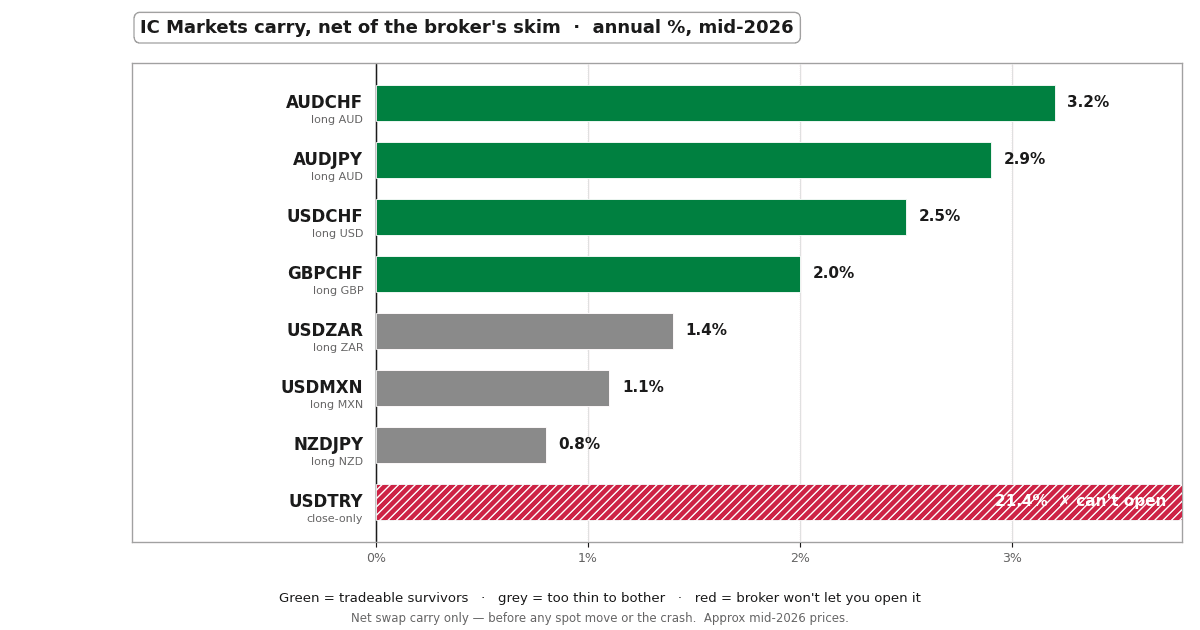
Not with IC Markets' own swap table. After the broker's cut, the best pairs pay only 2 to 3% a year (AUD/CHF 3.2%). The big emerging-market gaps shrink to about 1%. The pair that pays the most, USD/TRY at 21.4%, is close-only, so you cannot open it.
What is a carry trade?
The carry trade is the oldest idea in currency trading. It works like this:
- You buy a currency with a high interest rate.
- You pay for it by borrowing a currency with a low interest rate.
- Every night, you keep the difference between the two rates.
In theory, the high-rate currency should get weaker by about the same amount, so the profit cancels out. In real life, it usually does not. So the interest difference keeps coming in. That is the edge.
But you are not being clever by collecting it. You are being paid to hold a risk that nobody else wants. Most days, the trade brings small, steady profits. Then every few years there is a panic. Everyone sells the high-rate currencies at the same time, and the trade drops hard. Traders describe it as picking up coins in front of a moving steamroller.
The broker takes a cut
There is a problem that ruins the carry trade for normal traders, and it has nothing to do with the theory.
In MetaTrader, the broker pays you the interest difference through a nightly swap (an interest payment or charge for holding a trade overnight). The broker keeps part of it. Usually it charges more on the currency you borrow than it pays on the currency you hold. So the interest you really get can be very small, or even negative, even when the gap in a textbook looks big.
So the first step is not to write code. The first step is to open the broker's own swap table and read the real numbers. One hour of checking is better than a month of building.
That is what we did. We opened the IC Markets swap list for eight carry pairs. We worked out what each one really pays after the broker's cut. No EA (automated trading program), no backtest, no data download. Here is the full result.
Eight pairs, after the broker's cut
| Pair | Carry direction | Net carry, %/yr | Read |
|---|---|---|---|
| AUDCHF | long AUD | 3.2% | best survivor |
| AUDJPY | long AUD | 2.9% | shrinking as Japan hikes |
| USDCHF | long USD | 2.5% | clean |
| GBPCHF | long GBP | 2.0% | worst skim of the survivors |
| USDZAR | long ZAR (short USD) | 1.4% | too thin |
| USDMXN | long MXN (short USD) | 1.1% | too thin |
| NZDJPY | long NZD | 0.8% | dead |
| USDTRY | long TRY (short USD) | 21.4% | close-only, cannot open |
These are gross carry numbers. That means swap income only, before the price moves even one pip and before any crash. The prices we used are approximate mid-2026 levels. But the swaps come exactly from the broker's table. A few percent of error in price does not change the order of the list.
An example of the broker's cut
Look at USDMXN. The Mexican peso has a truly high interest rate. The raw interest gap over the US dollar is roughly five percent a year.
- To collect it, you want to own the peso. That means you sell USDMXN.
- The broker pays you 54.8 points a night for that.
- On the other side, if you buy USDMXN, the broker charges you 244.1 points a night.
The difference between these two numbers is the broker's cut, and it is very large. After the cut, the five percent gap reaches your account as 1.1 percent. The broker keeps roughly three quarters of the carry.
USDZAR shows the same thing at 1.4 percent. The big emerging-market interest gaps that traders chase are real. But the broker takes almost all of them.
NZDJPY was a favourite carry pair for many years. Now Japan is finally raising interest rates, so the gap has almost closed. After the cut it pays 0.8 percent a year. It is dead. You could find that out in the time it takes to open one window.
The exact rules of every strategy we've put on trial, how we tested each one, and what the data showed. 12 case files so far, free with your email.
The four best pairs are really one trade
Four pairs pay a reasonable two to three percent: AUDCHF, AUDJPY, USDCHF and GBPCHF. But look at what they have in common.
All four borrow a safe-haven currency: the Swiss franc or the Japanese yen. A safe haven is a currency that people buy when they are afraid. AUDCHF, USDCHF and GBPCHF all sell the franc.
So these are not four separate bets. They are one bet in four different forms. It is the classic carry bet that nothing bad will happen. On the day a panic comes, scared money runs into the franc and the yen. Then all four trades lose at the same time. The steady two to three percent a year is what you are paid for carrying that one hidden risk.
AUDJPY has a second problem. Its carry is getting smaller as the Bank of Japan raises rates. The number in the table is shrinking even now.
The best-paying pair is the one you cannot trade
USDTRY is shown at the bottom of the chart in red. On paper it pays 21.4 percent a year. That is by far the highest carry on the list.
But IC Markets has set it to close-only. You can close a trade you already have, but you cannot open a new one. The broker will not let you stand in front of that steamroller.
Even if it did, the Turkish lira has been falling by something like twenty to thirty percent a year. That fall in price cancels the 21 percent carry. So the best-paying carry on the whole list is the one pair you are not allowed to trade.
What the hour told us
This quick check answered the only question that mattered. At IC Markets, a realistic carry trade pays at most about three percent a year. It comes from a few pairs that are all the same bet against a panic. The one truly big opportunity is locked away. That is not a good base for a rules-based strategy. It is a small payment, after the broker's cut, that can crash at any time.
There was a second reason we stopped before writing code. A fair carry backtest is very hard to build. The MetaTrader strategy tester uses one fixed swap value for the whole history. But in a carry trade, the swap is the whole profit.
The Swiss franc had negative interest rates until 2022. Then the Swiss central bank raised rates, and later it cut them again. Using today's swap for seven years of history would give a false result. A fair test needs a swap that changes with the real interest rate history, coded by hand. That is the month of work this one-hour check saves you.
We have seen this before. The last carry idea we actually built was the Wednesday triple-swap trade. It collected its carry on time every single week. It still lost a fifth of the account, because the price moves were much bigger than the interest income.
This time the swap table told us the same ending before we wrote any code. The carry is real. But after the broker takes its share, it is not worth the risk of holding it. Checking took one hour. The hard part is to trust that answer and not build the strategy anyway.
The exact rules of every strategy we've put on trial, how we tested each one, and what the data showed. 12 case files so far, free with your email.
Run the numbers yourself
The free calculators behind the sizing and robustness checks in this test. No signup.