Half of a Journal of Finance Effect Is Still Real. It Pays Less Than the Commission.
Top research journals say a currency tends to fall during its own country's trading hours. We tested this on EURUSD tick data. The European part still works, at 0.75 pips per trade. But the cost is 0.7 pips.
Does the FX session cycle still work on EUR/USD?
Half of it works, but it does not make money. On 2019 to 2022 tick data, the European-hours trade still earns about 0.75 pips per trade before costs. Commission is about 0.7 pips, so only about 0.05 pips is left. The US-hours trade worked the other way and lost.
What is the FX session cycle?
The idea is simple: a currency tends to fall during its own country's working hours. The euro tends to fall during the European day. The dollar tends to fall during the American day.
Why? During their working day, local companies and investors buy more foreign currency than they sell. So they sell their own currency, and it goes down a little. You can see this in order flow (the data on who is buying and who is selling).
This idea has better research behind it than anything else we have tested:
- Breedon and Ranaldo described it in the Journal of Money, Credit and Banking in 2013.
- Krohn confirmed the 24-hour cycle in a Journal of Finance paper in 2024.
- Traders have tested it too. They came with a warning that matters later: the profit per trade is only a few pips, and costs can easily destroy it.
How the strategy works on EURUSD
The rules are mechanical:
- During European hours: sell EURUSD (we expect the euro to fall).
- At midday: close the sell and buy EURUSD instead.
- During US hours: hold the buy (we expect the dollar to fall).
- By 21:00 UTC: close everything. Never hold overnight.
That is two trades every weekday, about 520 per year. We only optimized the session start and end times and the emergency stop loss. That gave 27 combinations to test.
0 of 27 made money, but there was more to see
The full strategy lost money in every combination:
- Profit factors were 0.87 to 0.97. The profit factor is total wins divided by total losses, so anything below 1 loses money.
- Each test had about 1,558 trades.
- The best combination lost $1,676.
But before the test, we had planned one more step. We would split every trade by session and look at each half of the cycle on its own. That split gave us the real finding.
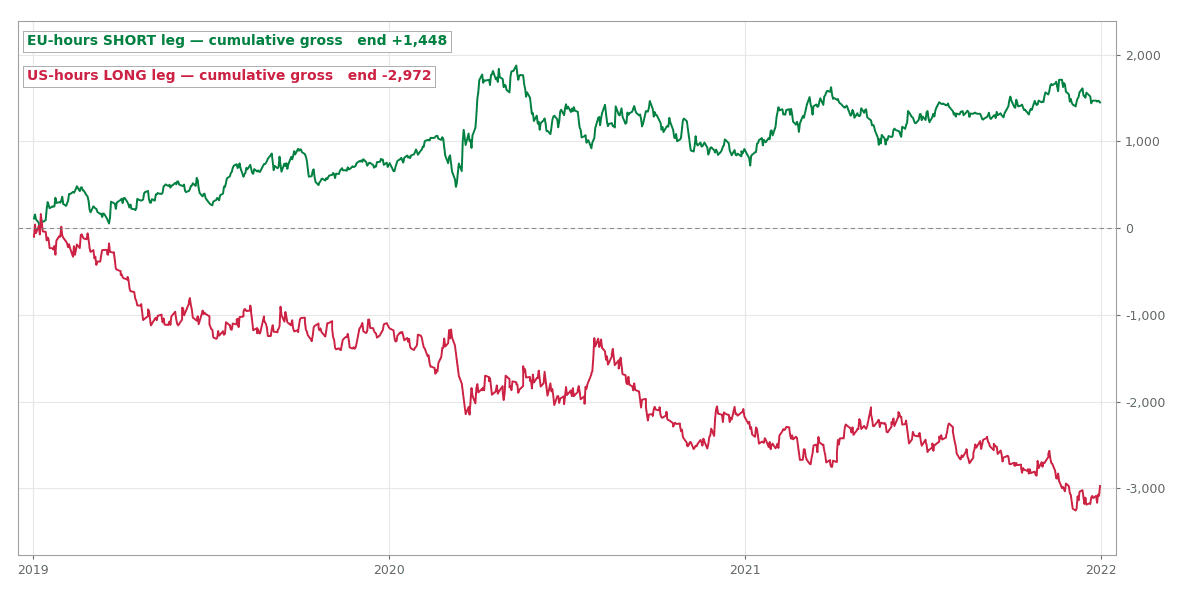
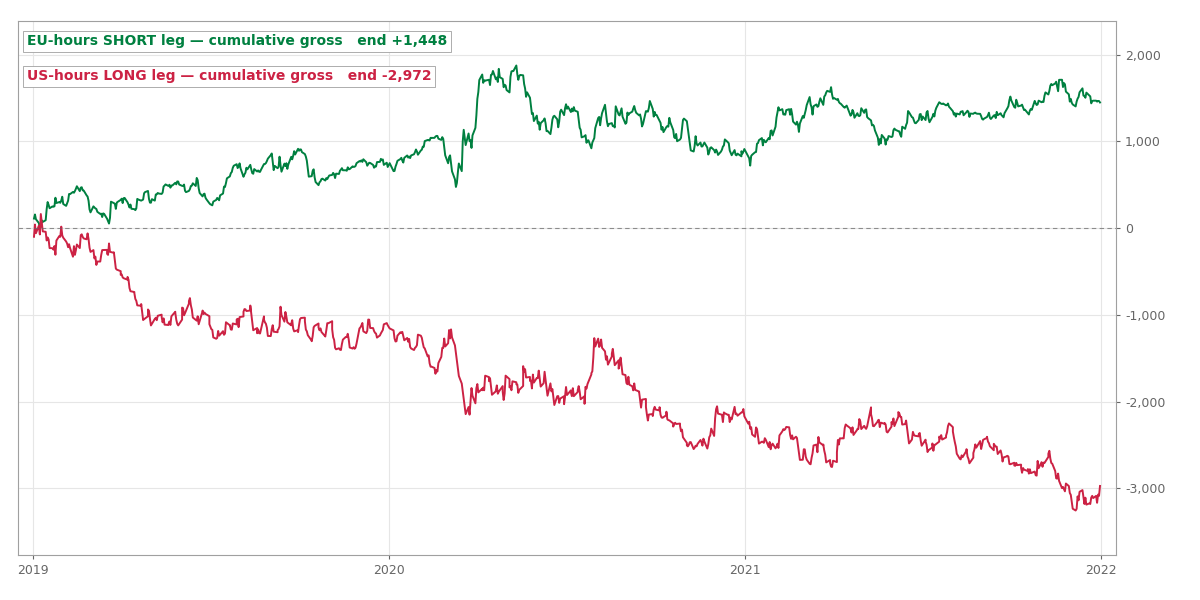 Cumulative gross price P&L per leg, 2019 to 2022. The European-hours short leg grows steadily to +$1,448; the US-hours long leg falls to -$2,972.
The European-hours sell really works. It made +$1,447.59 before costs in 780 trades. That is about 0.75 pips per trade, and it grew in an almost straight line for three years. So the research effect is still alive.
The US-hours buy worked the other way. It lost $2,971.92 in 778 trades. This makes sense for the period. The research expects the euro to rise during US hours. But from 2021 on, the dollar was very strong, and that crushed this trade.
The math that ends it
So why not drop the losing half and only trade the European sell? We had planned exactly that as version 2. But we did not even need to run it. Here is the math:
- In our cost model, one trade (open and close) costs about 0.7 pips in commission. The spread is already included in the prices.
- The European sell earns 0.75 pips per trade before costs.
- So what is left is about 0.05 pips per trade.
- The profit factor is so close to 1.0 that the difference is just noise. Our test needs at least 1.3 to pass.
No change to the session times, the stop size, or which half you trade can turn five hundredths of a pip into a real strategy.
The traders who tested this before warned us about exactly this. Now we have the numbers. The session cycle is a real fact about order flow. But it is not a trade for a normal trader. Big banks moving huge amounts can profit from it. An account that pays $7 per lot for each trade cannot.
A detail about trading hours that makes our verdict stronger
There is one detail that affects every strategy that closes "by 21:00":
- In US summer time (DST), the forex week ends at exactly 21:00 UTC on Friday.
- So on summer Fridays, a 21:00 exit never happens. The trades stay open over the weekend, until Monday.
- In this test, 82 of the 1,558 trades were held over the weekend like this. By chance, they made money: +$1,875 in price P&L.
If you close every trade on the same day (at 20:55), the strategy is about $1,700 worse than the numbers above. So our verdict is even stronger. We now have a fixed rule for all our strategies: same-day exits must be at 20:55 or earlier.
What we learned
We have now tested several ideas based on big order flows. Here is the pattern:
- Flows that happen in a short time leave a mark on the price. The gotobi payment flows (in Tokyo) and the London fix push a lot of orders into a few minutes. Both left an edge we could measure on out-of-sample data (newer data we keep aside for a final check).
- Flows spread over a long time do not. The session cycle spreads the same kind of pressure over whole trading days. After costs, nothing is left.
It is the same force in both cases. When it is packed into a short time, you can trade it. When it is spread out, you cannot.
The exact rules of every strategy we've put on trial, how we tested each one, and what the data showed. 12 case files so far, free with your email.
Run the numbers yourself
The free calculators behind the sizing and robustness checks in this test. No signup.